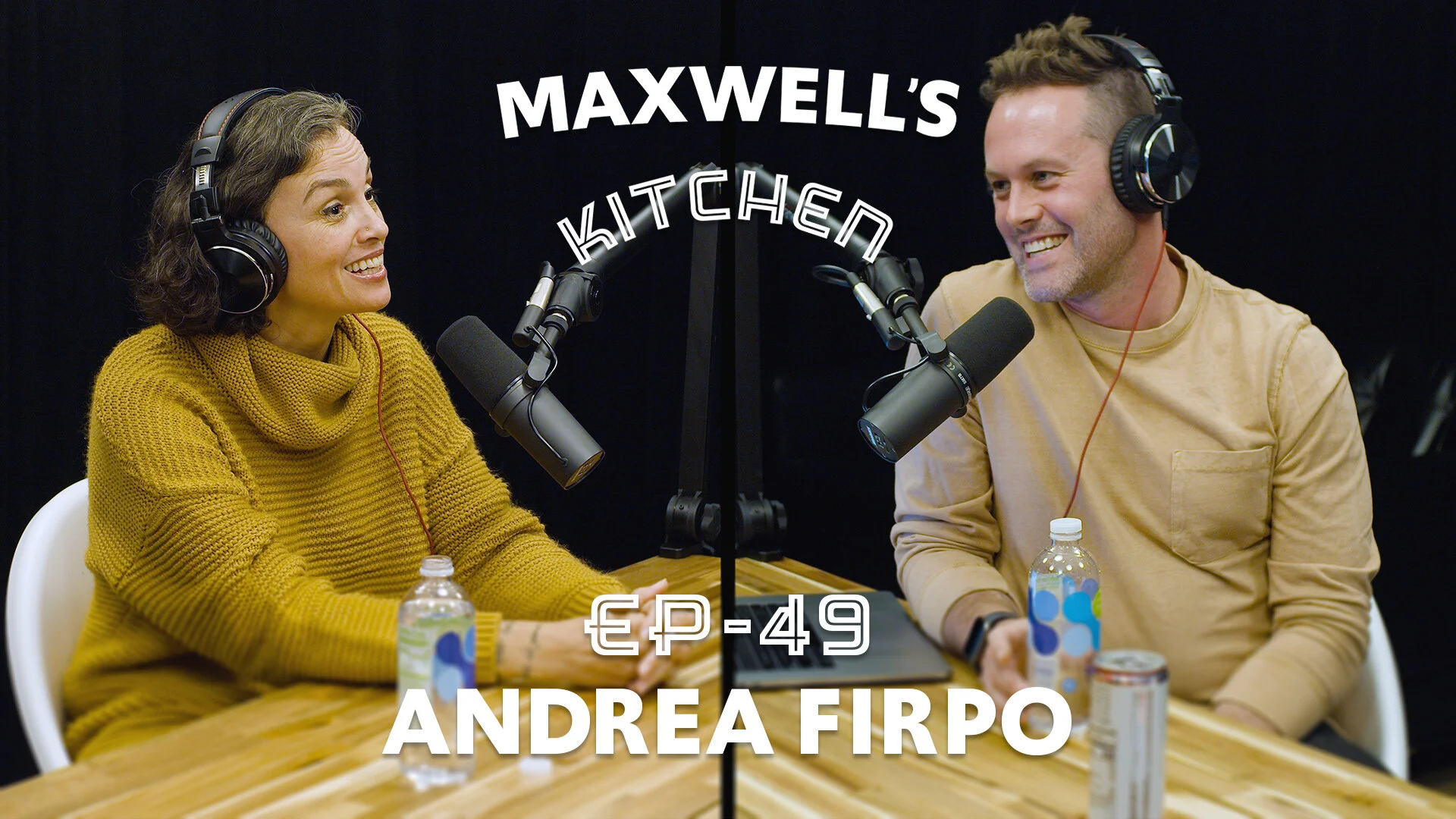
Andrea Firpo describes having a career, a marriage, a beautiful home, and a Porsche in the driveway. From the outside, her life in San Francisco looked like something she was supposed to want.
Privately, she says, she was crying in the bathtub and struggling to hold everything together.
A serious health scare pushed her to reconsider how she was living. She left her job, put her home on the market, and moved to Portland. Changing her surroundings gave her a different starting point, but understanding her relationships and responses took more than a new address.
In this episode of Maxwell’s Kitchen, Andrea and I discuss inner child healing, attachment patterns, and why recognizing a problem does not necessarily stop you from repeating it. She explains the spiritual ideas behind her work, while I ask how those ideas apply to relationships, ambition, parenting, and knowing when to change direction.
Eventually, my own dating habits become part of the conversation. I compare attraction to liking pizza. Andrea has some questions about that explanation.
In This Episode
How Andrea became known as the Psychic Cheerleader
Her experiences with abuse and emotional distress
Inner child work and recognizing emotional triggers
Her interpretation of anxious and avoidant attachment
Self-soothing, forgiveness, and boundaries
Her beliefs about past lives, karma, and reincarnation
Chakras, Reiki, and her introduction to energy work
Leaving San Francisco and starting over in Portland
Non-attachment and pursuing goals without controlling every outcome
Parenting and patterns passed between generations
Changing her relationship with alcohol
Recognizing familiar dynamics in romantic relationships
Guest
Andrea Firpo
Andrea Firpo describes herself as a Soul Liberation and Embodiment Guide. Her approach combines coaching, meditation, inner child work, and spiritual practices, including Reiki.
The name Psychic Cheerleader came from an astrologer Andrea visited after moving to Portland. According to Andrea, the woman looked at her chart and said she would want Andrea beside her if she were going through hell. The description stayed with her.
Andrea explains that she did not train as a psychiatrist or earn a psychology degree. She discusses her certifications, continuing education, and personal experiences as influences on the work she does.
Understanding an Emotional Reaction
I ask Andrea how she handles difficult feelings in her own life. Helping other people does not mean she never becomes upset or questions herself.
She describes learning to recognize feelings she associates with being young: vulnerability, abandonment, and needing reassurance. In her understanding of inner child work, identifying those feelings helps her respond with more compassion toward herself.
Rather than immediately suppressing an emotion, she talks about naming it and sitting with it. She sees that as a skill she had to learn because it was not something she knew how to do earlier in life.
That gives us a more specific question than simply asking how to feel better. What is happening in the moment when a reaction feels bigger than the situation in front of you?
Andrea’s approach begins with noticing that reaction and asking what it means to the person experiencing it.
When One Person Wants Reassurance and the Other Pulls Away
Andrea uses anxious and avoidant attachment as a framework for describing relationship conflict.
In her examples, one person reaches for closeness while the other becomes more distant. The person seeking reassurance feels increasingly exposed, while their partner experiences that need as pressure.
She connects those responses to what she calls the wounded child and the adaptive teen. These are the terms she uses to explain the dynamic, rather than a diagnosis of either person.
I ask whether understanding someone’s background makes it easier to live with them. Andrea believes recognizing a familiar response can help a person avoid treating every reaction as a complete statement about the relationship.
We also discuss the limits of trying to change someone else. Andrea describes learning that wanting to help does not mean another person is ready to participate. She recognizes that impulse in clients who begin learning something about themselves and immediately want to teach it to their families.
I know the temptation. Once something seems obvious to you, it can be difficult to understand why someone else does not want your explanation.
Forgiveness and Andrea’s Spiritual Perspective
When I ask whether Andrea has forgiven the people who hurt her, she says she has. She considers forgiveness important in her own life, while acknowledging that she does not force that choice on the people she works with.
The conversation then moves into her beliefs about spiritual lessons, reincarnation, and soul groups.
Andrea believes people can share more than one lifetime and encounter recurring lessons through different relationships. I ask how that works, why someone would choose painful circumstances, and what happens to individual identity after death.
These are spiritual interpretations she brings to the conversation. I do not share a fixed belief about them, but I want to understand the reasoning behind what she is saying.
We follow those questions through karma, choice, and whether someone could return as an animal. As often happens on this show, one answer opens several more questions.
Can Self-Improvement Become Another Thing You Never Finish?
I wonder whether constantly trying to become better can make it harder to appreciate the life you already have.
There is always another goal: a relationship, a house, a career change, or a version of yourself that seems more complete. If satisfaction depends on reaching the next thing, when do you actually get to enjoy anything?
Andrea recognizes that tension in spiritual and personal development too. Trying to perfect yourself can become another reason to feel dissatisfied.
She describes growth as something that happens in periods, with room to live between them. I like the question that raises about ambition. Wanting to change does not necessarily tell you which changes matter or how much of your attention they deserve.
That discussion eventually takes us into creativity, where Andrea explains her understanding of chakras and the movement of energy through the body.
How She Encountered Reiki
Andrea’s introduction to Reiki began with an interest in foraging and herbalism after moving to Portland.
She found a teacher who combined herbalism with Reiki sessions. Although Andrea did not continue in the herbalism program, she accepted a session and describes being surprised by the sensations she experienced.
She remembers tingling, changes in temperature, and getting up afterward wanting to know what had happened.
Andrea explains Reiki through her spiritual understanding of life-force energy and describes becoming a Reiki master teacher. I ask about training, consent, and how she understands the experience of giving or receiving a session.
Her account helps explain the direction her work took. It is her description of a personal experience and practice, rather than evidence of a medical treatment outcome.
Leaving San Francisco Did Not Settle Everything
When I ask who Andrea was before this work, she describes roughly twenty years working in the Bay Area, including roles as an executive assistant and senior office manager in technology, finance, and venture capital.
She says she drank and partied while struggling with experiences she had not resolved. Despite the appearance of success, she felt increasingly unable to continue as she was.
Her health concerns prompted her to seek help and consider substantial changes. Moving to Portland was something she had already wanted for years.
The relationship timeline is more complicated than simply leaving a husband and starting over. Andrea says she filed for divorce, later reconciled, and spent considerable effort trying to improve the relationship. Her husband commuted between the two cities for a period.
That experience connects to a lesson she returns to throughout our conversation: she could work on herself, but she could not do another person’s work for them.
She describes the first months in Portland as confusing. Other people questioned her decisions, and she had questions of her own. Starting over required living through that uncertainty.
Knowing When to Keep Trying
Andrea uses non-attachment to describe pursuing a goal without insisting that every step happen exactly as imagined.
I want to know where that leaves persistence. If you want a particular job or relationship, when should you keep trying, and when should you stop?
We use buying a house as an example. A listing can look perfect until you walk inside and discover something you cannot accept. Deciding against it may give you room to consider a place you had overlooked.
Andrea sees similar possibilities in other parts of life. She wants to put effort into what matters while remaining open to information that changes the decision.
Her explanation includes a belief that the universe participates in that process. My questions stay close to the choices themselves: what do you know, what are you assuming, and what are you refusing to reconsider?
My Pizza Theory Does Not Get Very Far
Near the end, I suggest that attraction may be something you simply like, even when you know it is not good for you. If you like pizza, you like pizza.
Andrea suggests looking more closely at what feels familiar in the people I choose.
She believes relationships can repeat unresolved dynamics from earlier life. I admit that I am the friend whose friends ask why he keeps dating the same kind of person.
That exchange brings the conversation back from its larger spiritual questions to something I recognize immediately. A pattern can be clear to everyone around you while remaining difficult to explain from inside it.
Andrea’s interest is in helping people notice those patterns and consider different choices. Across our conversation, I keep asking what that looks like in ordinary life, where understanding yourself and actually doing something differently are not always the same experience.
Andrea shares personal experiences and spiritual beliefs in this interview. The conversation is not medical advice or a substitute for qualified mental health care.
Useful Links
Watch Andrea Firpo’s Interview on YouTube
https://www.youtube.com/watch?v=UnVDv3qiq0I
Andrea Firpo’s Website
https://www.andreafirpo.com/
Explore More Maxwell’s Kitchen Interviews
https://maxwellskitchenpodcast.com/podcast/interviews
More Interviews
Emily Rose on Hypnosis, Anxiety, and Childhood Experiences
https://maxwellskitchenpodcast.com/maxwells-kitchen-podcast/2021/12/09-episode-53-emily-rose
Emily discusses her approach to hypnosis and inner child work, the boundaries she places around her practice, and the expectations people carry into adulthood.
Taylor Canoso on Divorce With Kids and the Guilt of Leaving
https://maxwellskitchenpodcast.com/maxwells-kitchen-podcast/2022/02/24-episode-59-taylor-canoso
Taylor shares her experience of separation, parenting, and deciding to leave a marriage while considering what that change means for her children.