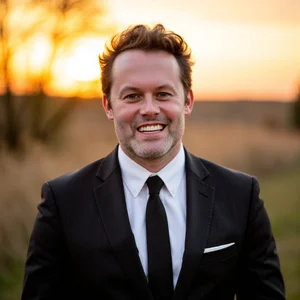
Brian Ravenswood remembers being surrounded by people who disliked Donald Trump long before Trump ran for president. He attended art school in Greenwich Village, worked as a designer and illustrator, and spent much of his life in New York City.
He voted for Trump anyway.
I want to understand that decision. I consider myself liberal, and I don’t share Brian’s enthusiasm for him. But hearing why someone made a choice seems more useful than deciding I already know everything about them because of it.
In this episode of Maxwell’s Kitchen, Brian explains his distrust of career politicians, his objections to Hillary Clinton, and his preference for candidates with experience outside government. We also discuss media bubbles, free speech, political identity, and our shared frustration with the choices available.
Brian has strong opinions. I have questions, disagreements, and a few frustrations of my own.
In This Episode
Growing up in Manhattan and the Bronx
Art school and political arguments during the Reagan years
Brian’s experience working in news graphics
Media bubbles and attitudes toward the rest of the country
His distinction between liberalism and leftism
Free speech and political conformity
COVID-19 policies and distrust of institutions
Career politicians and the two-party system
Why Brian voted for Donald Trump
Hillary Clinton and the appeal of an outsider
Cultural exchange and appropriation
Portland, policing, and public safety
Guest
Brian Ravenswood
Brian Ravenswood is a political blogger living in the Pacific Northwest. He grew up in New York City and worked as a designer, illustrator, and graphic artist before moving west.
His blog, The Creative Conservative, gives him an outlet for his views on politics, culture, and the direction of the country. In our conversation, he describes a conservative outlook shaped partly by his experiences in environments where he felt people assumed everyone agreed politically.
Art School With a Side of Reagan
Brian grew up attending public schools in Manhattan and the Bronx. He remembers classmates and friends whose families came from many different countries, and teachers who shared experiences that stayed with him.
Art school in Greenwich Village brought another kind of education. During the Reagan years, he says, political criticism could appear in classes that were supposed to be about animation.
He recalls teachers and classmates expressing views across the political left, including support for communism. His own interest in history gave him reasons to question some of what he heard, and those disagreements became part of late-night conversations.
Brian describes learning when to keep his opinions to himself. His comparison is being a Yankees fan surrounded by Red Sox fans: after a while, you know how the conversation is likely to go.
He does not describe a single moment when everything changed. His account is a collection of arguments, observations, and experiences that gradually left him feeling less aligned with the people around him.
The City He Loves and the Bubble He Criticizes
Brian’s criticism of New York sits alongside obvious affection for growing up there.
He tells me about traveling to a Korean neighborhood in Queens with a friend who wanted the hottest food the restaurant could serve. According to Brian, the staff watched his friend eat it and were impressed enough to give them the meal for free.
Brian ordered chicken and rice. His commitment to the adventure had limits.
He also remembers becoming a regular at an Afghan restaurant near his home. Those encounters are part of what he values about the city: being able to experience different cultures without traveling very far.
His frustration is with an attitude he believes he encountered among some educated, white-collar New Yorkers. He felt they treated people outside their world as less sophisticated or less important.
Having worked in media, he worries that those assumptions influence how other people and places are represented. I ask how we distinguish our own experiences from the picture we get through news coverage and social media.
When Disagreement Becomes a Verdict
One of Brian’s central arguments concerns the distinction he makes between liberalism and leftism.
He associates liberalism with open discussion and individual freedoms. He uses leftism to describe a more rigid political outlook that, in his view, treats disagreement as something to suppress.
That is Brian’s framework for the conversation. I ask what he means by the labels because they can cover very different ideas depending on who is using them.
We discuss the experience of being assigned an entire identity because of one opinion. A disagreement about a policy becomes an assumption about your motives, character, and everything else you believe.
I tell Brian that I consider most of my views liberal, but I want room to hear other arguments and revise my thinking. The prospect of everyone retreating into groups that refuse to speak to one another is depressing.
Our discussion of COVID-19 policies follows that same concern. We talk about mandates, social pressure, and distrust of institutions. This portion reflects our personal experiences and opinions rather than medical guidance.
Why He Preferred Someone Outside Politics
When I ask Brian directly why he supported Trump, he begins with Trump’s business background and the fact that he was not a career politician.
Brian sees government as too willing to tolerate failure. He wants someone who will demand results, and he believes Trump’s public image appealed to people who felt the same way.
I question whether that image demonstrates concern for ordinary people. My impression of Trump is much more skeptical. Brian responds with his own understanding of Trump’s appeal and the connections he believes Trump has with working people.
Eventually, I ask whether another outsider could have earned his support just as easily.
Brian says he would have supported other businesspeople. His answer helps clarify the decision: dissatisfaction with the political establishment is a substantial part of what drew him to Trump.
Hillary Clinton and the Choice He Felt He Had
Brian’s explanation also depends on who Trump was running against.
He strongly distrusts Hillary Clinton and describes her candidacy as another version of the politics he wants to move away from. For him, the election presented a choice between someone he already opposed and someone who might do things differently.
His support for Republicans comes with considerable disappointment too. He names candidates he voted for without liking them and complains about politicians failing to follow through.
That is something I recognize, even though we approach the choices differently. Neither of us describes feeling well represented.
We discuss whether more parties would help and whether political experience should carry as much weight as it does. Brian says he would rather consider someone who has spent years working an ordinary job than automatically favor someone with prestigious credentials.
A Detour Into Space
When I ask what might give people something constructive to pursue, Brian’s answer takes us out of politics for a while.
He wants to see space become a place for industry, exploration, and new opportunities. He imagines that kind of shared ambition producing possibilities we cannot yet anticipate.
It is a noticeably more hopeful part of a conversation in which he often sounds worried about decline. I ask why returning to the moon and expanding beyond Earth have not happened in the way earlier generations imagined.
Brian’s ideas are speculative, but they reveal something about what interests him beyond elections. He wants a future that feels worth building.
Portland and the Wish for Better Choices
Toward the end, we return to where we live.
Brian is deeply frustrated with Portland’s leadership and public safety. I talk about missing the nightlife, restaurants, dive bars, and live music that made me enjoy being here.
We discuss policing, protests, property damage, and the Kyle Rittenhouse case. Brian places much of the responsibility on political leaders. I share concerns about the consequences of people being left to confront dangerous situations themselves.
The conversation ends with Brian wishing he had candidates he actually wanted to vote for. Supporting a party, he says, does not mean liking everyone in it.
We do not settle our disagreements about Trump. But I leave with a clearer understanding of Brian’s decision, including how much of it comes from being disappointed by the alternatives.
Useful Links
Watch Brian Ravenswood’s Interview on YouTube
https://www.youtube.com/watch?v=8kf7HTRwYtY
Explore More Maxwell’s Kitchen Interviews
https://maxwellskitchenpodcast.com/podcast/interviews
More Interviews
Schyler Reis on Music, Environmental Science, and Tribalism
https://maxwellskitchenpodcast.com/maxwells-kitchen-podcast/2021/01/26/episode-27-schyler-reis
Schyler brings stories about music and art alongside a discussion of environmental science, climate change denial, and tribalism.
Ashlen Hilliard on Coercive Control and Leaving a Group
https://maxwellskitchenpodcast.com/maxwells-kitchen-podcast/2022/01/12-episode-57-ashlen-hilliard
Ashlen discusses her own religious upbringing, helping people leave controlling communities, and why she is careful about labeling someone else’s experience.