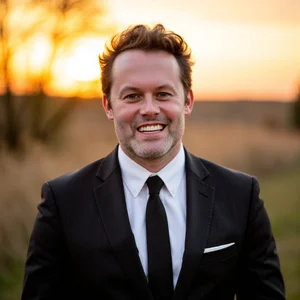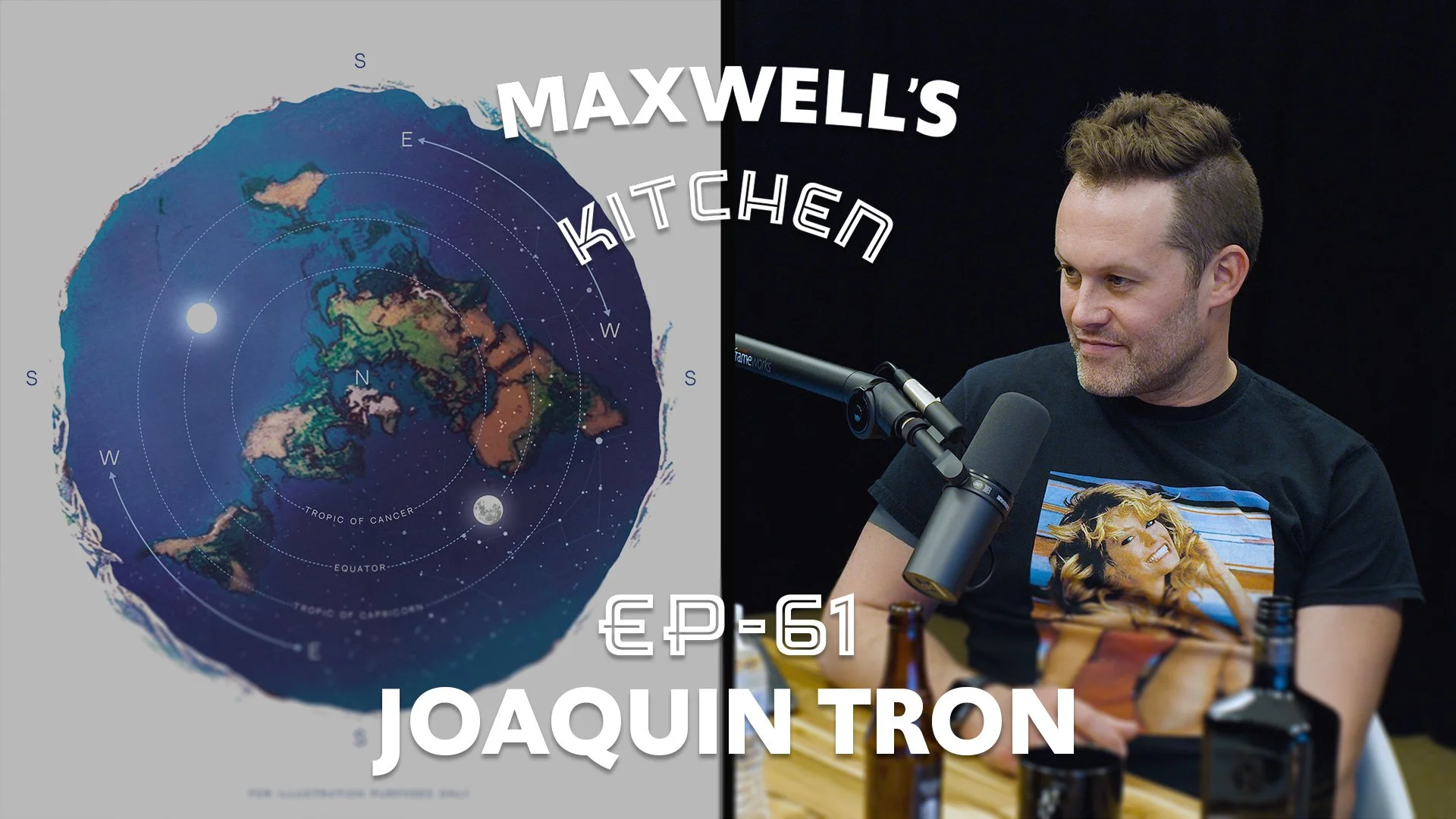
Joaquin Tron used to play in a space-rock band. He bought the Cosmos series with Neil deGrasse Tyson and projected it during shows. Space was part of the music, the imagery, and the conversations after practice.
Now he doesn’t believe we live on a spinning globe.
I wanted to understand how someone makes that change. In this episode of Maxwell’s Kitchen, Joaquin explains his flat-earth beliefs, why he distrusts NASA, and the observations he considers convincing. I ask about Antarctica, day and night, the seasons, gravity, photographs from space, and what would change his mind.
The conversation also gets into what happens when he shares those beliefs with people close to him. A discussion about the shape of the Earth can become a much more personal conversation about trust, family, and whether anyone wants to spend the rest of the evening arguing about it.
In This Episode
How Joaquin became a flat-earth believer
Space documentaries, music, and alternative theories
Flat-earth maps and his interpretation of Antarctica
Questions about edges, space, and what lies underneath
His explanations of day, night, and the seasons
Stars, constellations, eclipses, and orbital motion
NASA imagery and his distrust of space agencies
Religion, creation, and meaning
Gravity, water, horizons, and curvature arguments
What would change his mind
Talking about flat earth with family
UFO theories, censorship, and freedom of speech
Pandemic policy and political polarization
Guest
Joaquin Tron
Joaquin is a husband, father, and musician who describes himself as a globe skeptic. His interests include alternative explanations of the world, institutional trust, and the assumptions behind things people accept as settled.
In this conversation, he presents his own beliefs and the material that persuaded him. He also acknowledges questions he cannot answer and distinguishes his rejection of the globe from having a complete explanation of everything that would replace it.
From Space Documentaries to a Different Map
Joaquin traces the beginning of his interest to conversations after band practice around 2009.
Someone would bring a video, and the group would watch material about space, ancient civilizations, the Mayan calendar, aliens, or other theories. He describes enjoying the feeling that the world might contain more than the version he had grown up understanding.
Eventually, some of the political material became depressing. He stepped away for a while and concentrated on his life.
Then, in 2015, a friend started sending him unusual images. One was a map presented as an alternative view of the world. At first, Joaquin thought it was simply an abstract or esoteric picture. Looking further brought him into flat-earth videos and arguments that changed how he interpreted what he was seeing.
The important part of his story is that he remembers being interested in space before becoming skeptical of it. He sees himself as someone who changed his mind after investigating something, rather than someone who had always rejected the globe.
What Happens at the Edge?
My first question is fairly predictable. If the Earth is flat, what happens at the edge?
Joaquin says the image of a disc floating in space with water pouring off it doesn’t represent what he believes. He shows me a map with the North Pole at the center, continents arranged around it, and Antarctica forming an outer perimeter.
In his interpretation, Antarctica is more like the shoreline around a large body of water. He argues that access restrictions prevent people from freely exploring what might lie beyond it.
I ask why someone from the movement hasn’t simply gone to investigate. We discuss his understanding of the Antarctic Treaty, expeditions, and access. He makes several claims about restrictions, while also acknowledging uncertainty about particular journeys.
When I ask what lies underneath the surface or beyond the perimeter, he doesn’t offer a definite answer. Those are areas where he says he would be speculating.
How Would Day, Night, and Seasons Work?
Once the map is on the screen, I try to work through how ordinary experiences would fit it.
Joaquin describes a nearby Sun moving in circles above the surface. In his explanation, its path shifts between the tropics over the year, producing the seasons. He interprets sunset through distance and perspective rather than the Sun passing below a curved horizon.
That leads into questions about stars, constellations, eclipses, and the motions described by the heliocentric model. He considers the repeating patterns in the sky difficult to reconcile with those motions.
I keep asking how the different pieces would work together. With eclipses, he says he doesn’t have a complete explanation.
He also tells me about a trip around the world with his wife. He sees their route as compatible with moving in a circle on the flat-earth map. That becomes another example of how he can accept an experience while interpreting its geometry differently.
Why He Distrusts NASA
The conversation eventually reaches the obvious question: what about pictures of Earth from space?
Joaquin disputes their reliability. He brings up Apollo footage, the Blue Marble image, image processing, and his belief that NASA presents manufactured material as evidence of space.
His position depends heavily on distrust of the institutions providing the images. Showing him something from NASA doesn’t settle the question because NASA itself is part of what he questions.
I ask why anyone would want to conceal the shape of the Earth in the first place. He talks about uncertainty, control, and the sense of completeness he associates with looking at a globe.
The discussion also becomes spiritual. Joaquin says some people within the movement connect their beliefs to biblical creation, although he doesn’t present himself as a biblical authority. For him, questioning the globe also connects to questions about meaning and humanity’s place in existence.
What Would Change His Mind?
I ask whether going into space and seeing Earth for himself would convince him.
He says yes. He returns to his earlier enthusiasm for space and says he would accept evidence that genuinely persuaded him.
At the same time, he draws a distinction between believing the Earth is flat and believing he can explain its full structure. His strongest conviction, he says, is that the spinning-globe account is wrong.
We discuss the observations he considers most persuasive: water finding its level, long-distance visibility, laser experiments, the Chicago skyline, and ships at the horizon. He interprets those through his beliefs about perspective, density, buoyancy, and curvature.
Those are his arguments for rejecting the globe. My questions keep returning to how they would account for the world as a whole, rather than one image or observation at a time.
The Conversation That Lasted Until Three in the Morning
One of the more revealing parts of the interview comes when Joaquin describes telling his family.
He remembers going to a baseball game with his mother shortly after becoming convinced. He was excited and wanted to share what he thought he had discovered. She seemed open during that conversation, but the subject didn’t become something they continued discussing.
Later, hearing dismissive comments about flat earthers made him less willing to bring it up.
At his brother’s bachelor party, a conversation about the Moon landings led someone to ask whether he believed in flat Earth. Several hours later, Joaquin and his brother were still talking in a hotel lobby.
He remembers his brother eventually saying he simply didn’t have time to think about it.
That stayed with him. He understood that people had jobs, families, and obligations. But he also found it difficult to be so interested in something that the people around him didn’t want to discuss.
From the Shape of the Earth to Distrust of Institutions
The final part of our conversation moves into online censorship, alternative media, pandemic policy, and political polarization.
Joaquin connects those subjects through the same underlying concern: who gets to decide which explanations people encounter, and how much confidence should anyone place in institutions?
We discuss platform moderation, fact-checking, and his belief that dissenting voices are being excluded. As fathers, we also talk about our frustrations and concerns around school policies, masking, and the effects of restrictions on family life.
The conversation includes opinions about public-health decisions and political incentives. It becomes increasingly clear how closely his flat-earth beliefs sit alongside a much broader distrust of government, media, and institutional authority.
By the end, Joaquin tells me he doesn’t expect one conversation to convince me. I tell him I’m interested in hearing his case without saying I’m convinced.
The detail I keep coming back to is the space-rock band. The person describing NASA as untrustworthy is also the person who once put space documentaries behind his music. Hearing him explain how he got from one to the other is what made me want to have the conversation.
Useful Links
Watch This Episode on YouTube
https://www.youtube.com/watch?v=9Z2woWtX6HM
More Maxwell’s Kitchen Interviews
https://maxwellskitchenpodcast.com/podcast/interviews
More Interviews
Human Evolution, Extinction Events & Why We’re Still Here with Stephen Frost
https://maxwellskitchenpodcast.com/maxwells-kitchen-podcast/2023/01/25-episode-103-stephen-frost
Stephen discusses human origins, fossils, extinction events, and how researchers use evidence to understand the history of life.
Brandon LaPier on Alien Abduction, Psychic Experiences & Parallel Realities
https://maxwellskitchenpodcast.com/maxwells-kitchen-podcast/2022/05/02-episode-72-brandon-lapier
Brandon shares experiences he describes as paranormal and extraterrestrial, and explains how they shaped his understanding of consciousness and reality.