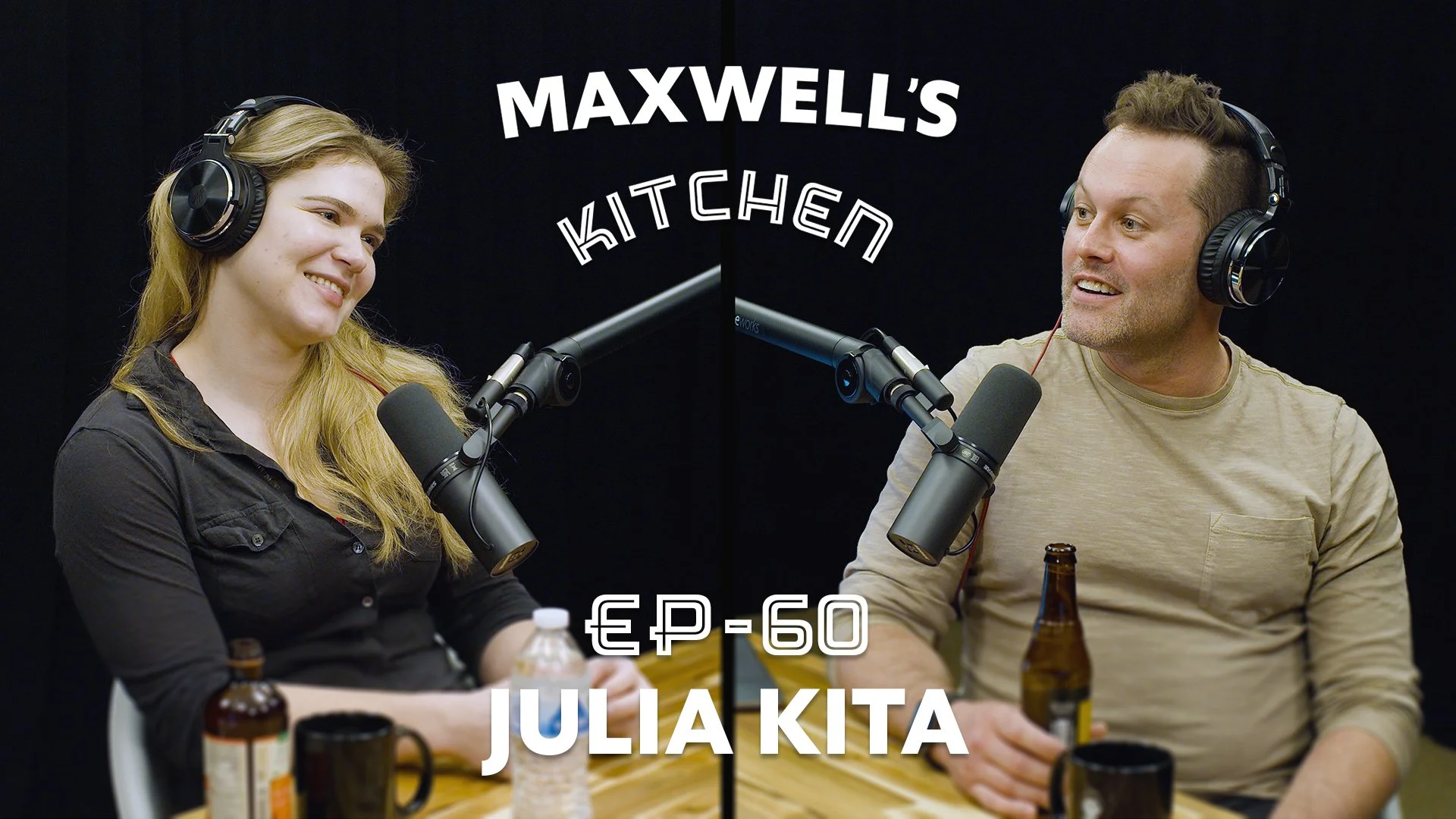
Julia Kita was at her grandmother’s house when she called a strip club in Salem and asked whether they were hiring. A few weeks past her 21st birthday, she had no dance experience, no outfits prepared, and no heels. The person on the phone told her to come in that day.
Once she arrived, she nearly left. It was daytime, the club was quiet, and the reality of what she was about to do felt considerably more intimidating than making the phone call. A DJ offered her a spare pair of heels. Before long, she had a job.
Julia is also an engineering student, which gives me approximately a million questions about how these parts of her life fit together. In this episode of Maxwell’s Kitchen, we talk about working as an exotic dancer, discovering pole dancing, and opening a pole dance studio in Portland. Her favorite part of the work turns out to be the part she knew almost nothing about when she walked through the door.
In This Episode
Starting exotic dancing while attending college
Her first shift and learning from other dancers
Finding connection and stepping into a different persona
Club schedules, music, earnings, and customer interactions
Keeping the job secret from her boyfriend
Introversion and feeling comfortable onstage
Learning static and spinning pole
Strength, momentum, freestyle, and choreography
Teaching beginners in small classes
Returning to school for a second engineering degree
Guest
Julia Kita
Julia Kita owns a pole dance studio in Portland, Oregon. She began learning pole while working as an exotic dancer during college and started teaching during the pandemic. Alongside teaching group classes and private lessons, she is pursuing a second engineering degree.
Starting Before She Felt Ready
When I ask what drew Julia to exotic dancing, my first assumption is money. She says that was not the biggest reason. Looking back, she remembers loneliness, a desire for connection, and an environment that felt welcoming to her, even when the work itself was uncomfortable.
She is careful about what that connection meant. It did not necessarily turn into close friendships with the other dancers. There was something about being around them that felt familiar, though, and the job offered an escape from her everyday life. She could use a different name, move differently, and interact with people as someone other than the person they might meet outside the club.
That possibility appealed to someone who describes herself as extremely introverted and conscious of her body. It did not make the first day easy. Borrowing shoes and getting hired did very little to answer the more immediate question of what she was actually supposed to do onstage.
Another dancer helped introduce her to the pole. Julia remembers touching it and discovering that it moved, a detail that also comes as news to me during this conversation. Apparently, I have spent years watching people spin without investigating which parts of the equipment were participating.
The Work Between Performances
College shaped Julia’s schedule. She could usually commit to a Friday or Saturday, sometimes working a long Saturday that stretched from noon until around three in the morning. Daytime could be quiet; late weekend nights brought a different energy, with more people wanting her attention and fewer opportunities to sit by herself.
Her account includes plenty of ordinary working details that are easy to miss from the customer’s side. Dancers waited their turn in the lineup, dealt with different expectations about appearance, and worked within music choices that could depend on the club or the DJ. Earnings varied with who happened to come through the door.
In her experience, income came from tips and private dances, with the club taking a portion of private-dance revenue. She also tipped the DJ and security. Regular customers could make earnings more predictable, although the attention sometimes included persistent invitations and even marriage proposals.
Julia enjoyed some conversations and found others tiring. Approaching strangers to sell dances was never her favorite part. She worked sober and describes being able to brush off many unpleasant interactions, but she also recounts someone following her car after work. She eventually lost the person. It is a frightening part of her story, alongside her description of security walking dancers out.
Keeping a Large Part of Her Life Secret
At first, Julia told almost nobody about the job, including her boyfriend. She describes their relationship as toxic and says keeping things from each other had become normal. She did not expect him to understand why she wanted to dance.
The secret lasted roughly a year. Then a conversation about makeup gave it away. Julia did not usually wear makeup outside work, and an offhand comment about wearing it on weekends prompted more questions. Eventually, she told him.
She stopped working at the club and stayed in the relationship.
When I ask whether she misses dancing, Julia immediately comes back to performing. Over time, learning pole had become much more than figuring out what to do during a shift. She enjoyed building a collection of movements, finding combinations, and expressing something through music. Leaving the job did not remove her interest in that.
Feeling More Comfortable on the Stage
For Julia, being introverted and enjoying performance fit together more easily than people sometimes expected. Other dancers occasionally questioned why someone so quiet was working there. From her perspective, the stage could be the least nerve-racking part of the night.
Performing gave her something to concentrate on. She could listen to the music, go inward, and move. Talking to an unfamiliar customer required a different kind of effort.
As she learned, music began following her beyond the club. Hearing a song could bring movements into her head, and she started listening more widely because different music suggested different ways to perform. She still sometimes guest performs, using a mixture of planned choreography and freestyle. Her choices can range from aggressive electronic music to classical pieces, depending on how she feels.
What interests her is the freedom within it. A performance can have a structure without requiring every movement to be decided in advance.
Figuring Out How the Movement Works
Julia had lifted weights before she started, and that strength helped. She also credits her ability to watch another dancer and work out how a movement happens: where an arm goes, how a leg moves, and what creates the momentum.
She explains the distinction between a static pole, which stays fixed, and a spinning pole, which rotates. Each changes how she uses force and controls speed. Learning a new move becomes a puzzle she can keep building on, especially once it opens up another combination.
There is a lot of physical work involved, but Julia enjoys having a reason to do it beyond counting repetitions. She would rather work through a combination than persuade herself to finish another set at the gym.
Even clothing becomes part of understanding the movement. When I ask about what she likes to wear while practicing, Julia describes shorts and a sports bra or short top. She explains how exposed skin helps her grip the pole, while fabric can protect areas where contact would be uncomfortable. Her story about a student arriving covered in coconut oil makes the importance of grip particularly memorable.
Teaching Pole Without Leaving Engineering Behind
During the pandemic, Julia decided to start teaching. She had knowledge she wanted to share and enjoyed the activity enough to make it part of her working life.
Her studio has five poles, keeping group classes small. That matters because students arrive with different abilities and learn at different speeds. A smaller group gives her more opportunity to help someone who is struggling while another student picks up the movement quickly.
When I suggest that pole might not be for everybody, Julia pushes back. She sees room for different bodies, abilities, and styles. Someone can enjoy moving around the pole without pursuing the most demanding tricks. The students she describes often want to get stronger, feel more confident, learn a skill, or try exercise that looks fun.
Teaching has limits for her, too. After several classes, she feels drained by the amount of energy she gives people. She loves teaching when she has the energy for it, but does not want to do it full time.
Engineering remains part of her life. She completed her first degree while working in Salem and is now pursuing another, without insisting that it lead to one predetermined job. Following a rigid plan did not work particularly well the first time, she says, so she is leaving more room for opportunities she cannot yet predict.
She certainly did not know where that phone call from her grandmother’s house would lead. Now she gets to watch beginners discover something she recognizes: the pleasure of trying a movement, figuring it out, and immediately wanting to see what else is possible. She compares it to adults playing on a jungle gym. After an hour of talking about clubs, school, work, and performing, that is the image she leaves me with.
Useful Links
Watch Julia Kita’s Interview on YouTube
https://www.youtube.com/watch?v=fRoI2f_MlZE
Explore More Maxwell’s Kitchen Interviews
https://maxwellskitchenpodcast.com/podcast/interviews
More Interviews
Megan Diana on Piano Push Play, Music, and Building a Creative Life
https://maxwellskitchenpodcast.com/maxwells-kitchen-podcast/2022/06/16-episode-79-megan-diana
Megan talks about finding her way back to music and starting Piano Push Play, a Portland project that puts pianos in public spaces for anyone to play.
Jaime Mathis on Leaving a Religious Cult and Starting Over
https://maxwellskitchenpodcast.com/maxwells-kitchen-podcast/2022/04/04-episode-66-jaime-mathis
Jaime shares her experience of growing up in a religious community she describes as a cult, leaving familiar expectations, and exploring life through travel.