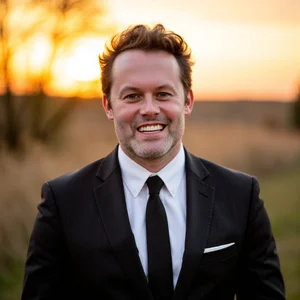
Mark Gamba had the kind of career a lot of people dream about.
He traveled the world as a professional photographer, shooting assignments for National Geographic, Sports Illustrated, Outside, Men's Journal, and major commercial clients. He learned to climb, kayak, scuba dive, and work underwater partly because the more things he could do, the more places somebody could send him with a camera.
Then the things he was photographing started bothering him.
On assignments, Mark was seeing glaciers retreat, coral reefs change, and evidence of climate change appearing earlier than he expected from the science he had been reading. Instead of continuing to document it from behind a camera, he eventually decided he wanted to be involved in changing policy.
That decision took him from photography into the planning commission, Milwaukie City Council, the mayor's office, and a run for the Oregon Legislature.
In this episode of Maxwell's Kitchen, we talk about Oregon politics, climate change, housing, homelessness, transportation, Portland's unusual form of government, political money, renewable energy, and why seemingly simple public problems become so difficult to solve.
Then, after more than an hour of politics, we go back to the career Mark left behind and talk about National Geographic, underwater photography, hammerhead sharks, shooting film at 120 feet, and what it took to build a life around photography before everybody carried a camera in their pocket.
In This Episode
Oregon politics and local government
Serving as mayor of Milwaukie
Running for Oregon House District 41
Pay for elected officials
Housing affordability and homelessness
Wealth inequality and political money
Campaign finance
Jobs, automation, and offshoring
Portland's form of government
Climate change and public policy
Transportation and congestion pricing
Public transit and bicycle infrastructure
Nuclear power
Wind and solar energy
Energy-efficient buildings
Oregon building codes
National Geographic photography
Sports Illustrated assignments
Commercial photography
Underwater photography
Hammerhead sharks in the Cocos Islands
Shooting professionally on film
Guest
Mark Gamba
Mark Gamba entered politics after a long career as a professional photographer.
His photography work took him around the world for editorial and commercial assignments, including work for National Geographic and Sports Illustrated. The same career that allowed him to photograph remarkable places also exposed him to environmental changes that eventually pushed him toward climate advocacy and public office.
Our conversation begins with Mark serving as mayor of Milwaukie, Oregon, and campaigning for a seat in the Oregon House of Representatives.
The Strange Economics of Public Service
One of the first things we talk about is money.
Not campaign money yet. Paychecks.
Mark explains that many elected positions in Oregon pay surprisingly little compared with the time required to do the work properly. State legislators may officially be in session for limited portions of the year, but constituent work, policy research, meetings, bill writing, and preparation do not politely stop when the session ends.
Local government can be even stranger.
As mayor of Milwaukie, Mark says he was being paid roughly $300 a month.
That creates an obvious problem. If serving effectively requires something close to full-time attention but the job does not provide anything resembling a full-time income, the pool of people who can realistically do it becomes very small.
You need another income source, substantial savings, a flexible career, or enough financial security to effectively donate a huge amount of your time.
That does not necessarily produce a government representative of the people living under it.
Housing Has Become the Elephant in the Room
The conversation moves quickly from government salaries into housing because the two problems are connected by the same basic issue: ordinary life has become dramatically more expensive.
I had recently bought a house in Gresham and told Mark what the market had been like. Offers tens of thousands of dollars over asking were normal, and houses that did not seem remotely luxurious were moving into price ranges that would have sounded absurd only a few years earlier.
Mark's larger concern is what happens when even two working professionals struggle to buy a modest home.
If a teacher and an attorney are barely hanging on, what does the housing market look like for somebody working at a coffee shop, warehouse, restaurant, or retail store?
Housing also runs directly into homelessness.
Mark argues that it is difficult to talk seriously about people living on the street without talking about the cost of housing, wages, addiction, mental health, social services, and the larger economic system surrounding all of them.
That complexity is part of what makes the issue so frustrating.
Everybody can see the problem.
Agreeing on what caused it, who owns it, and what government should actually do next is much harder.
Why Portland Government Became Part of the Conversation
When we recorded this episode, frustration with Portland was everywhere.
Homelessness was highly visible. Crime was a constant subject of conversation. People across the political spectrum seemed convinced that basic problems were not getting solved.
Mark's explanation focuses less on one politician and more on the structure underneath them.
Portland's government operated through an unusual commission system in which elected commissioners were also assigned responsibility for individual city bureaus. Mark contrasts that with Milwaukie's council-manager structure, where elected officials establish priorities and policy while professional administrators run departments and figure out how to execute those priorities.
His criticism is straightforward: complicated problems rarely stay inside one department.
Homelessness can involve housing, transportation, police, public works, sanitation, land, behavioral health, and social services. If those departments are divided among separate elected officials protecting separate portfolios, coordination becomes harder.
A city can have plenty of people working on a problem and still struggle to move in one direction.
That distinction, between setting policy and managing operations, becomes one of the more interesting parts of the episode because it gets underneath the easier question of which individual politician deserves the blame.
The Photography Career That Led to Politics
Mark did not grow up planning to become a politician.
He wanted to be a photographer.
National Geographic was the dream.
Instead of only studying photography, he deliberately learned skills that would make him useful in difficult places. He became comfortable kayaking and rafting whitewater, learned rock and ice climbing, started scuba diving young, camped, backpacked, and prepared himself physically for assignments that might require much more than knowing how to operate a camera.
The goal was simple: if somebody called with an assignment, he wanted as few reasons as possible to say he could not do it.
Eventually, he got the call.
Mark worked as a contract photographer for National Geographic along with other magazines, including Sports Illustrated, Outside, and Men's Journal. Editorial work provided the incredible assignments, while commercial photography for companies such as Adidas, Jeep, and UPS provided much more of the income.
That combination allowed him to make a living while doing the kind of editorial photography he had dreamed about as a kid.
Then the subject matter started changing the photographer.
Seeing Climate Change Through a Camera
Mark had read the climate science and understood the broad predictions, but seeing environmental changes while traveling made the issue much more immediate.
He describes witnessing changes in the natural world that he believed were happening significantly earlier than expected.
For somebody accustomed to observing things carefully for a living, that was difficult to ignore.
The 2000 presidential election became another major turning point for him. Climate policy was already important to Mark, and watching the political direction of the country change pushed him toward the conclusion that simply paying attention was not enough.
He started locally.
First came the planning commission. Then City Council. When he became frustrated that ideas were not being implemented at the pace he thought they should be, he ran for mayor.
The progression makes more sense when he tells it than it does on a résumé.
Photography taught him to notice what was happening.
Politics became his attempt to do something about it.
Transportation Is a Climate Problem
Transportation becomes one of the most specific climate-policy discussions in the episode.
Mark argues that switching every gasoline-powered car to an electric car will not happen quickly enough by itself. His preferred approach also involves changing how cities move people.
We talk about congestion pricing, where driving a single-occupancy vehicle into a particularly busy area at certain times carries an additional cost. Cities can then use that revenue to improve transit, bicycle infrastructure, and other alternatives.
The goal is not simply collecting a toll.
It is changing the economics of the decision.
If driving into a congested area becomes more expensive while transit becomes easier, faster, and more useful, some people will choose something other than the car.
Mark also talks about induced demand, the frustrating phenomenon where adding lanes to a crowded highway can encourage enough additional driving that the new capacity eventually fills up too.
Build another lane.
Everybody uses it.
Congratulations, you have invented a wider traffic jam.
Wind, Solar, Nuclear, and the Boring Stuff That Actually Matters
We also get into energy.
Mark is skeptical that large conventional nuclear plants can come online quickly enough to serve as the main answer to climate change, although he is more interested in the potential of smaller reactor technologies.
He is much more enthusiastic about wind, solar, and reducing the amount of energy buildings require in the first place.
That last part is not nearly as exciting as arguing about nuclear power.
It may also be one of the more useful pieces of the conversation.
Mark talks about insulation, windows, building codes, and efficiency standards. A new building may stand for a century, so relatively modest improvements made during construction continue reducing energy use decade after decade.
He gives the example of an affordable housing project where relatively small increases in construction cost produced dramatically lower utility bills.
Nobody is putting triple-pane windows on a campaign poster.
They still matter.
Money Makes Everything Harder
Eventually almost every policy discussion in the episode runs into money.
Campaign finance.
Corporate profits.
Fossil fuels.
Healthcare.
Housing.
Manufacturing.
Mark's argument is that many problems we describe as technologically difficult are not really waiting for somebody to invent a solution. We often already know how to make buildings more efficient, generate renewable energy, improve transportation, or reduce emissions.
The obstacle is deciding who pays, who loses revenue, who gains power, and which interests have enough influence to slow the change.
We do not agree on every detail throughout the conversation, which is part of what makes it interesting.
I keep coming back to how difficult it is to untangle enormous bills, competing priorities, jobs, corporate interests, and the unintended consequences of changing one part of the system.
Mark keeps returning to the idea that complexity cannot become an excuse for doing nothing.
That tension runs through most of the political part of the episode.
Diving With Hammerhead Sharks on 36 Frames
Then we leave politics almost completely.
One of Mark's favorite assignments took him to the Cocos Islands, hundreds of miles off the coast of Costa Rica, where he photographed hammerhead sharks for Sports Illustrated.
Getting there required roughly a day and a half on a boat. Once there, the diving was extraordinary: schools of hammerheads, barracuda, tuna, and a photographer trying to get close enough to make a useful picture.
This was film.
Mark had 36 frames in a camera underwater.
Thirty-six.
No looking at the back of the camera to see whether the exposure worked. No firing off 2,000 frames and sorting it out later. At depth, changing film was obviously not an option.
That meant knowing the exposure, flash, distance, composition, and equipment before pressing the shutter.
Underwater photography made everything harder because water strips colors from light as depth increases. At around 120 feet, much of the warmer spectrum is gone, leaving the scene overwhelmingly blue and green. The flash effectively brings full-spectrum light back to the subject for the photograph.
Mark eventually figured out that getting the hammerhead image he wanted meant diving with far fewer people. A crowd of divers and bubbles kept the sharks at a distance.
On a later dive, he went down with one divemaster.
A hammerhead came within roughly five feet.
He got the shot.
From Watching the World to Trying to Change It
The funny thing about Mark's story is that politics looks like a dramatic career change until you listen to him describe the two careers together.
Photography taught him to pay attention.
It taught him to go somewhere unfamiliar, understand what was happening, work under difficult conditions, and come back with evidence of what he saw.
Eventually, he felt that observing was not enough.
The political work is messier, slower, less glamorous, and considerably worse paid than traveling around the world taking photographs.
There are days, Mark admits, when going back to photography sounds pretty appealing.
But he also talks about the stubbornness required to keep working on something even when the scale of the problem feels ridiculous.
That may be the strongest connection between the two halves of his life.
The photographer looks closely at what is happening.
The politician asks what he can do about it.
Useful Links
Mark Gamba
https://www.markgamba.com/
Mark Gamba Photography
https://www.markgambaphoto.com/
Watch This Episode on YouTube
https://youtu.be/mYqH3YlbGbA
More Interviews
Missoula Floods, Ice Age Floods, and Pacific Northwest Geology | Scott Burns
https://maxwellskitchenpodcast.com/maxwells-kitchen-podcast/2023/02/16-episode-106-scott-burns
Geologist Scott Burns takes the environmental conversation in a completely different direction, explaining the catastrophic Ice Age floods that shaped Oregon and Washington before getting into glaciers, climate change, sea level rise, and how to read the landscape around us.
Inside Portland Fire & Rescue: Stories from a Retired Firefighter and Historian | Don Porth
https://maxwellskitchenpodcast.com/maxwells-kitchen-podcast/2022/09/13-episode-89-don-porth
Don Porth offers another view from inside Portland public service, tracing a career with Portland Fire & Rescue through firefighting, emergency response, public education, fire prevention, and the history of the department.