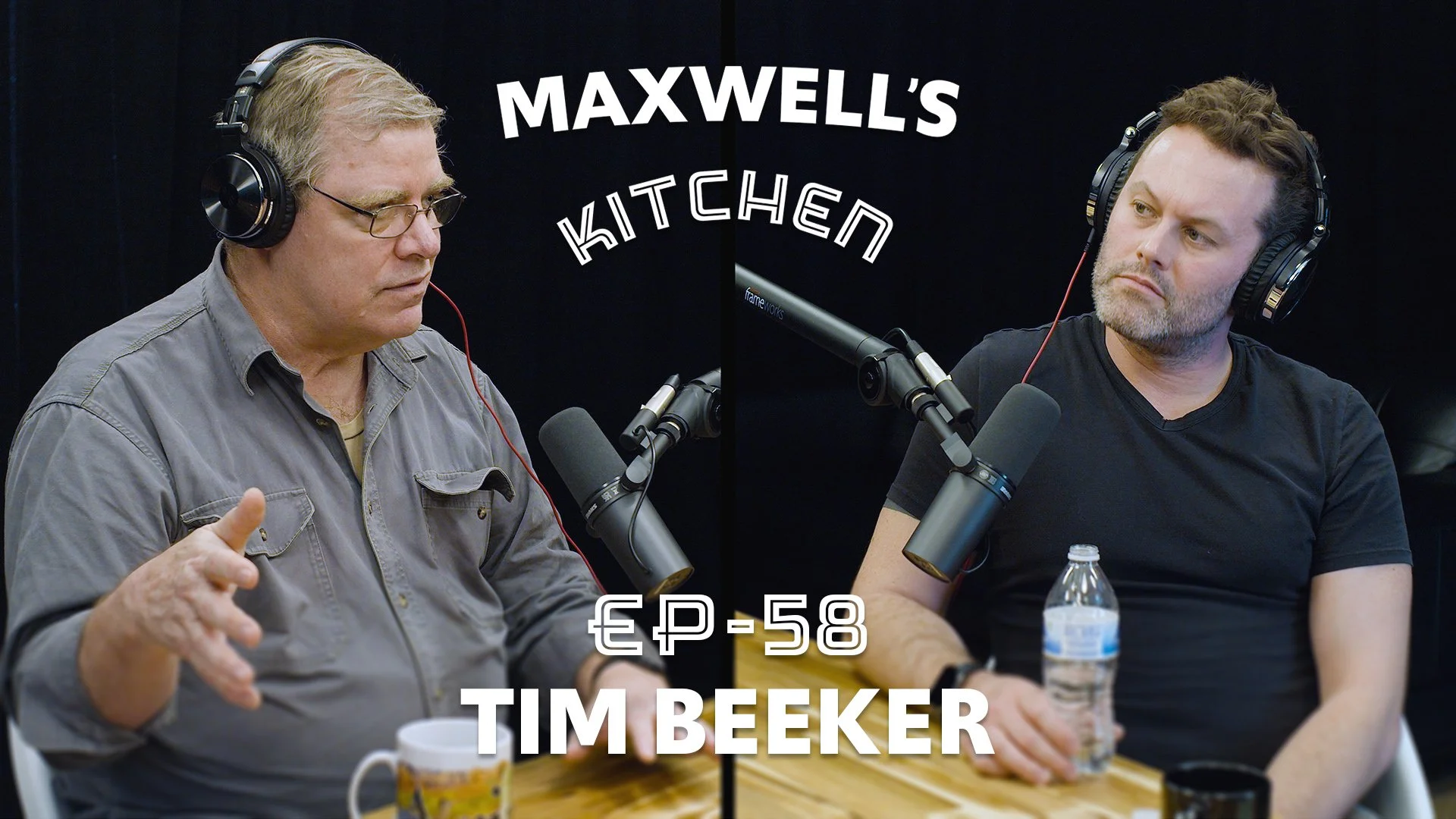
The first time Tim Beeker came to Maxwell’s Kitchen, we talked about his job transporting people who had died. This time, he arrives with a book about the Bible and an argument he knows many Christians will disagree with.
Tim believes Christianity has misunderstood much of the Torah and its relationship to Jesus. He has spent years thinking about those disagreements, asking questions in churches, and developing the arguments in his book, The Gold of Torah, The Silver of Messiah, The Copper of Judgment: 50+ Arguments Supporting Messianic Apologetics.
I have questions of my own. How does he decide which interpretation is right? What separates evidence from belief? Would he change his mind if another religion could demonstrate that it was true?
We spend most of this conversation working through those questions. But we also return to the work Tim has left behind, the people he misses helping, and his interest in finding another way to show up for someone during a terrible day.
In This Episode
Why Tim left mortuary transport
Writing a book about Messianic apologetics
His argument that Christians misunderstand Torah
Biblical interpretation and religious traditions
Creation, Jesus, and questions about evidence
Bible translations and the Dead Sea Scrolls
Prophecy and Tim’s expectations about the future
The afterlife, judgment, and free will
Whether upbringing determines religious belief
What might change his mind
Helping people through grief and loss
Guest
Tim Beeker
Tim Beeker is a writer, public speaker, and returning Maxwell’s Kitchen guest. He describes himself as a Torah-observant Messianic believer and has written a book presenting his arguments about the relationship between Torah, Jesus, and Christian teaching.
His previous work in mortuary transport brought him into close contact with death and grieving families, experiences that also shape our conversations about purpose and how people treat one another.
Leaving a Job He Still Misses
Tim is no longer doing the mortuary transport work we discussed in his first interview. He gives two main reasons: changes in management after the company was sold and the physical toll of moving bodies.
His back became the more immediate problem. He describes pain that could interrupt an entire day and work that sometimes required moving a heavy person down several flights of stairs. Whatever satisfaction he found in helping families, his body was struggling with the demands.
Leaving did not make him stop caring about the job. He still hears stories from former coworkers and wonders whether they attended a scene he sees in the news. Driving past the workplace, he finds himself looking for signs that the team is out working.
He also wishes there had been more attention to training. With a degree in education, Tim felt he had something to contribute beyond the physical tasks. In his account, those ideas did not receive the attention he hoped for.
The departure gave him time to finish something he had been considering for years.
Turning Years of Questions Into a Book
Tim traces the development of his book back to around 2005. After leaving the job, he decided to sit down and write the arguments he had been carrying around.
He calls the work apologetics, a defense of his religious position. Its central concern is the difference he sees between what Christians teach and what he believes the Bible says.
When I ask whether he considers himself a biblical expert, Tim says no. He describes himself as more widely read than many Christians he encounters, while acknowledging that he has not followed a formal seminary education.
That distinction matters to how he presents himself. He wants people to examine his arguments and challenge them. He also recognizes that his way of questioning people can become confrontational, even when he intends it as an exchange of ideas.
A book gives him another way to have that conversation. Readers can consider what he has written without having him standing in front of them.
Why He Keeps Returning to Torah
When I ask which part of the Bible he thinks is most misunderstood, Tim immediately answers: Torah.
His argument is that Christians often treat its instructions as no longer applicable while continuing to draw selectively from its passages. He believes the relationship between Torah and Jesus should lead people toward a different understanding of how to live.
That takes us into creation, the meaning of a day in Genesis, religious holidays, Sabbath observance, and his objections to traditions he associates with the Roman Catholic Church. Tim presents those objections from his own Messianic perspective.
I keep asking what following that perspective would mean in everyday life. If someone accepted his argument, what would they actually do differently?
His first answer is to study. He believes reading more deeply would gradually change a person’s understanding and behavior. Throughout the conversation, he returns to the importance of caring for others, which he sees as inseparable from the religious position he is defending.
Faith, Evidence, and a Very Old Book
Tim offers several reasons for his belief in God, including his interpretation of Israel’s history and biblical prophecy. I ask how those interpretations establish something beyond faith, especially when people have been connecting events to religious predictions for a very long time.
We also discuss Jesus and the reliability of biblical texts. Tim brings up manuscripts, textual criticism, and the Dead Sea Scrolls as reasons he finds the Bible trustworthy. My questions concern translation, interpretation, and how confidently anyone can understand a text that has traveled through so many languages and centuries.
There is a difference between the questions we are trying to answer. Tim wants to explain why his reading makes sense to him. I am asking how someone outside that belief system could determine that it is true.
That difference keeps resurfacing. He offers connections between passages; I ask how he rules out another interpretation. He describes the Bible as the foundation against which he evaluates other beliefs; I ask what would lead him to reconsider the foundation itself.
What Happens After We Die?
Given Tim’s former occupation, it is probably inevitable that we end up talking about the afterlife.
He is willing to say he does not know exactly what happens. He shares beliefs about resurrection, a renewed earth, and people coming to understand their lives in relation to Jesus. He does not claim he can determine who will be saved or describe every part of judgment.
I press him on what he actually imagines. Is there a being making a decision about each person? Do we judge ourselves? What does he believe happens between death and whatever comes next?
Tim moves between his interpretations of scripture and the limits of what he feels able to say. He also objects to using images of hell and punishment to frighten people into belief.
For all his confidence in the importance of Torah, there are questions where his answer remains uncertain.
What Would Make Him Change His Mind?
I ask whether Tim would abandon his beliefs if another religion could prove itself true. As a deliberately blunt example, I suggest Buddha showing up.
Tim says he would consider evidence, but he would evaluate it against Torah and his understanding of Jesus. That brings us back to the difficulty of testing a belief while using that same belief as the standard.
We talk about upbringing, too. If he had been raised somewhere else, would he hold the same convictions? Tim points to his curiosity and willingness to investigate, though neither of us can know how a different life would have shaped him.
The discussion eventually reaches free will. If God has unlimited power, I ask, why not make everyone good? Tim sees human choice as important. I continue wondering why an all-powerful creator would arrange things this way.
We do not arrive at a shared answer. Tim says he will probably spend the drive home thinking about what he should have explained differently. I suspect that is a familiar feeling for almost anyone who has tried to fit their understanding of existence into an hour.
The Part About Helping People
Near the end, Tim tells me how much he misses helping families through mortuary transport. He has considered whether there might be another way to support grieving people, perhaps through a nonprofit, although he does not know how to build the business side of it.
Then he tells a story about a family whose trailer burned. They lost their dog, and his wife called to ask whether he could collect the animal.
Tim went. He remembers the woman being too distressed to watch him carry the dog away and trying to reassure the family that his wife would take good care of it.
The gratitude mattered to him. He had done something useful for people who needed someone to help.
After all the discussion about interpretation, proof, and what happens beyond this life, Tim ends up describing a moment in this one. He connects that impulse to his faith: noticing someone’s distress and being willing to go out of his way to do something about it.
Useful Links
Watch Tim Beeker’s Interview on YouTube
https://www.youtube.com/watch?v=XU2OsEeDqGI
Tim Beeker’s Book on Amazon
https://www.amazon.com/dp/B09BGN8FBF
Explore More Maxwell’s Kitchen Interviews
https://maxwellskitchenpodcast.com/podcast/interviews
More Interviews
Tim Beeker on Mortuary Transport, Death, and Helping Grieving Families
https://maxwellskitchenpodcast.com/maxwells-kitchen-podcast/2021/02/08/episode-29-tim-beeker
Our first conversation explores transporting the deceased, finding purpose in difficult work, and helping families during moments of loss. This episode includes graphic descriptions.
Jaime Mathis on Leaving a Religious Cult and Starting Over
https://maxwellskitchenpodcast.com/maxwells-kitchen-podcast/2022/04/04-episode-66-jaime-mathis
Jaime shares her experience of leaving the religious environment she describes as a cult and questioning the expectations she carried into adulthood.