Jaime Mathis’s mother helped send her to college in England because she wanted her daughter back in an Adventist school. Jaime agreed because England was a very long way from home.
The arrangement technically satisfied both of them. What happened afterward probably wasn’t what her mother had in mind.
Jaime traveled around Europe, questioned beliefs she had grown up with, and started making decisions for herself. But leaving the strict Seventh-day Adventist environment she describes as a religious cult involved more than changing schools or deciding she no longer believed in God. Some of those expectations followed her much farther than she realized.
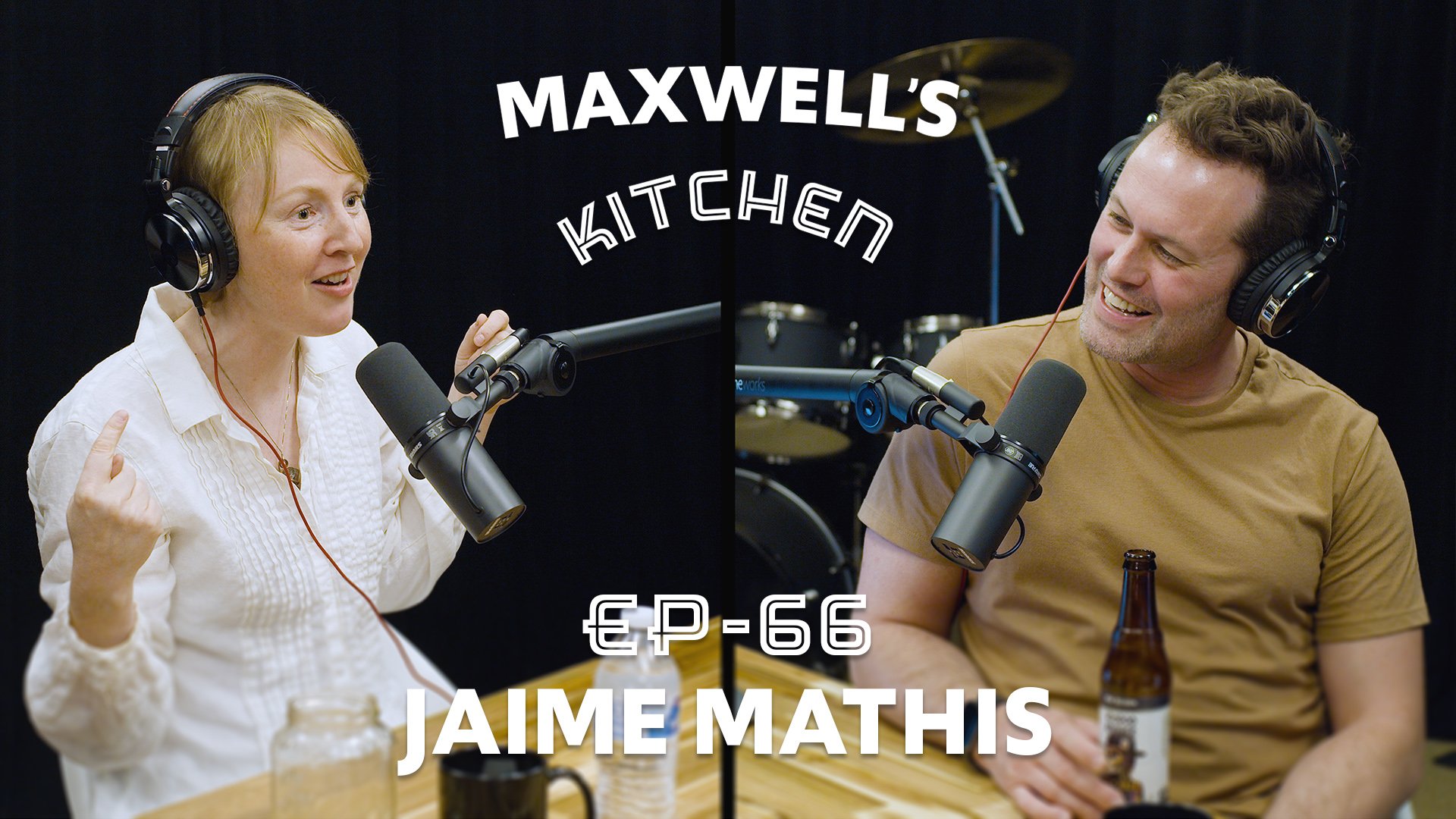
In this episode of Maxwell’s Kitchen, Jaime tells me about surviving childhood cancer, studying abroad, having a panic attack in Bangkok, and making a bucket list at 23. There are singing jobs, books, a Renaissance sword fighter, and a shoplifting story involving six area rugs. She came into the studio making me laugh, and we barely stopped for the next two hours.
In This Episode
Growing up in a strict Seventh-day Adventist environment
Leaving religion and questioning inherited beliefs
Surviving childhood cancer and going through chemotherapy
Studying in England and traveling around Europe
Experiencing September 11 while overseas
Planning to teach English in Thailand
A panic attack in Bangkok and returning to Portland
Making a bucket list at 23
Singing, acting, writing, and working in bookstores
A shoplifting arrest and questions about privilege
Identity, Jungian ideas, and yoga philosophy
Political communications and community involvement
Indigenous land stewardship and local government
Guest
Jaime Mathis
Jaime is a traveler, educator, yoga teacher, writer, mother, and childhood cancer survivor. In our conversation, she also describes her work in political communications and her interest in community, sustainability education, and local government.
Those interests connect to a life spent questioning the environments she found herself in. Sometimes that meant leaving. Sometimes it meant learning how a system worked so she could decide what she wanted to do inside it.
Childhood Cancer and the Feeling That She Owed God Something
When Jaime was eight, her mother found a lump while brushing her hair. More appeared, and she became increasingly tired. Jaime remembers a series of appointments and tests before her family learned she had cancer around Christmas.
She tells me about going to Stanford Children’s Hospital, being terrified of needles, and hearing adults discuss her condition around her hospital bed. Chemotherapy followed. Her long red hair, something she loved about herself, began falling out.
One of the details she remembers is standing at a mirror, pulling out loose handfuls and experimenting with increasingly ridiculous hairstyles. Her mother was devastated. Jaime was trying to find something she could control, even if it was giving herself a terrible comb-over.
She also remembers her mother staying beside her through treatment and her father making carrot juice every day. Becoming a parent herself later gave her another way to understand what that period had been like for them.
Within her religious upbringing, surviving acquired a particular meaning. Jaime says she was told God had saved her for a reason. She carried the feeling that her life had been spared for some enormous purpose, and that she needed to figure out what it was.
England Was Supposed to Keep Her in the Fold
Jaime describes a childhood where school, friendships, food, entertainment, and relationships were tightly connected to religion. She calls that world “Saturday Jesusland.”
After starting college at an Adventist school in Walla Walla, she transferred to Portland State. She had a scholarship, was studying toward a possible medical career, and was interning with her former oncologist at OHSU. For the first time, she was spending substantial time outside the religious environment she knew.
Her mother wanted her back in an Adventist school. Jaime eventually offered a deal: she would go if it was in England and her mother handled the arrangements and paid for it.
She expected to stay a year. She stayed three.
While there, Jaime began noticing inherited assumptions she didn’t agree with, including her reaction to seeing an interracial couple. Recognizing her mother’s voice in her own thoughts disturbed her. She wanted to understand what she actually believed and what she had simply absorbed.
The questioning extended to religion, drinking, relationships, and the future her family imagined for her. England gave her enough distance to start experimenting with a different life.
Seeing More of the World
Jaime drove around Ireland with friends and backpacked through Italy and Switzerland. She also spent a summer in Spain, learning Spanish and becoming fascinated by flamenco.
The travel stories come with less glamorous discoveries. Her description of British students introducing Americans to Marmite is unlikely to appear in an official tourism campaign. Neither is our discussion about how carefully you have to introduce a borrowed British accent before people notice what you’re doing.
She was also studying overseas when September 11 happened. Jaime remembers watching the television with other students and later visiting New York while rubble was still being removed.
Being abroad gave her a different perspective on the response. We talk about fear, national identity, and what it felt like to be American while watching events unfold from another country.
The Thailand Plan Lasted About a Day
After graduating with an English literature degree, Jaime wanted to keep traveling. Teaching English seemed like a way to support herself while doing it.
The plan was to fly into Bangkok with her best friend, continue to Chiang Mai for a teaching certification course, and use that qualification to work abroad. About 24 hours after arriving, she woke in a hotel convinced she was dying.
Jaime describes an overwhelming panic attack. Looking back, she connects it to several things arriving together: her childhood illness, her religious upbringing, family tensions, and suddenly being somewhere unfamiliar without the usual sources of reassurance.
Her friend helped her change her flight, but they couldn’t leave immediately. That produced a surreal day and a half of sightseeing, sapphires, tailored suits, and nearly getting scammed while Jaime waited to go home.
She remembers arriving at Portland International Airport, smelling the evergreen trees, and feeling she could breathe again. The relief of being home didn’t immediately answer what she was going to do next.
Making a Bucket List at 23
Jaime’s fear wasn’t resolved simply by deciding she no longer believed in God.
She describes a contradiction that stayed with her: she had rejected the religion, but part of her still feared that abandoning it meant breaking the bargain she believed had kept her alive as a child.
Convinced she might not live past 30, she made a bucket list.
She wanted to sing professionally, act, write books, and write enough songs for an album. She also wanted to become a barista because coffee had been forbidden growing up. Working in a bookstore mattered because books had been a refuge during her childhood.
Those ambitions led to singing on the Portland Spirit, theater work, writing, and a job at Auntie’s Bookstore in Spokane. A relationship with a Renaissance sword fighter helped take her in that direction geographically, which is where I begin feeling that almost any answer to my next question is possible.
Six Area Rugs and a Night in Jail
Eventually, Jaime tells me she spent a night in jail after trying to steal six area rugs.
I have several questions, beginning with why someone would choose something so large and difficult to hide.
Her explanation combines being broke, having a cold apartment, testing boundaries, and wanting to see how much her appearance affected what people assumed about her. She knew she looked respectable. She wanted to know what that would let her get away with.
The answer involved an arrest, missing a theater rehearsal, and acquiring the jail nickname “Rug Doctor.”
Jaime tells the story with humor, but she also describes becoming uncomfortable with how much she believed her race, education, appearance, and access to an attorney influenced the outcome. She says she completed a program and the incident came off her record.
For her, it became part of a larger interest in racial justice and how institutions treat different people. It also helped clarify that questioning every rule didn’t mean she agreed with breaking every one.
Coming Home and Getting Involved
Jaime describes herself as a salmon. She travels, lives elsewhere, and eventually returns to her headwaters.
She came back to Portland with her Danish husband to have their son. Motherhood brought another encounter with expectations she recognized from childhood, including assumptions about staying home and putting her own work aside.
Eventually, she returned to Portland State for a master’s degree in educational leadership and policy, with a focus on sustainability education. Through that work, she became involved in political communications.
We talk about local government because she sees it as a place where decisions can affect the people around her directly. Her interests include community, environmental stewardship, and involving Indigenous people in decisions about land.
That takes us into a much larger discussion about ownership. I own a house, but when you start asking why a particular piece of the planet belongs to one person, the conversation gets strange fairly quickly.
Working Out Which Rules Are Yours
The conversation eventually wanders through yoga philosophy, identity, spontaneity, and Jaime’s interest in hand analysis. She shares her interpretations of purpose and personality, while I ask how those ideas work.
But the question running through her stories is more familiar: how much of your life have you chosen?
Jaime doesn’t describe leaving religion as a moment when every old belief disappeared. The expectations resurfaced in her fear after Bangkok, her sense of obligation after surviving cancer, and her assumptions about motherhood.
She kept finding them in different places and deciding what to do with them. Sometimes the result was a new career or another country. Sometimes it was a mistake she could explain only afterward.
What I liked about talking with Jaime was how readily she let the funny, uncomfortable, and contradictory parts sit together. She could tell me something painful and have me laughing a minute later without making the painful part disappear. I could have kept asking questions for another three weeks.
Useful Links
Watch This Episode on YouTube
https://www.youtube.com/watch?v=S45--FVr5u4
More Maxwell’s Kitchen Interviews
https://maxwellskitchenpodcast.com/podcast/interviews
More Interviews
Lisa Kendall on Leaving “The Move of God”
https://maxwellskitchenpodcast.com/maxwells-kitchen-podcast/2021/11/16-episode-lisa-kendall
Lisa shares her experience growing up in a coercive religious group, leaving it, and working to protect people harmed in similar environments.
Dr. James Johnson on Trauma, the Nervous System & Human Behavior
https://maxwellskitchenpodcast.com/maxwells-kitchen-podcast/2022/04/08-episode-68-dr-james-johnson
James discusses his career in neuropsychology, emotional responses, self-awareness, and the relationship between his clinical work and personal spiritual interests.