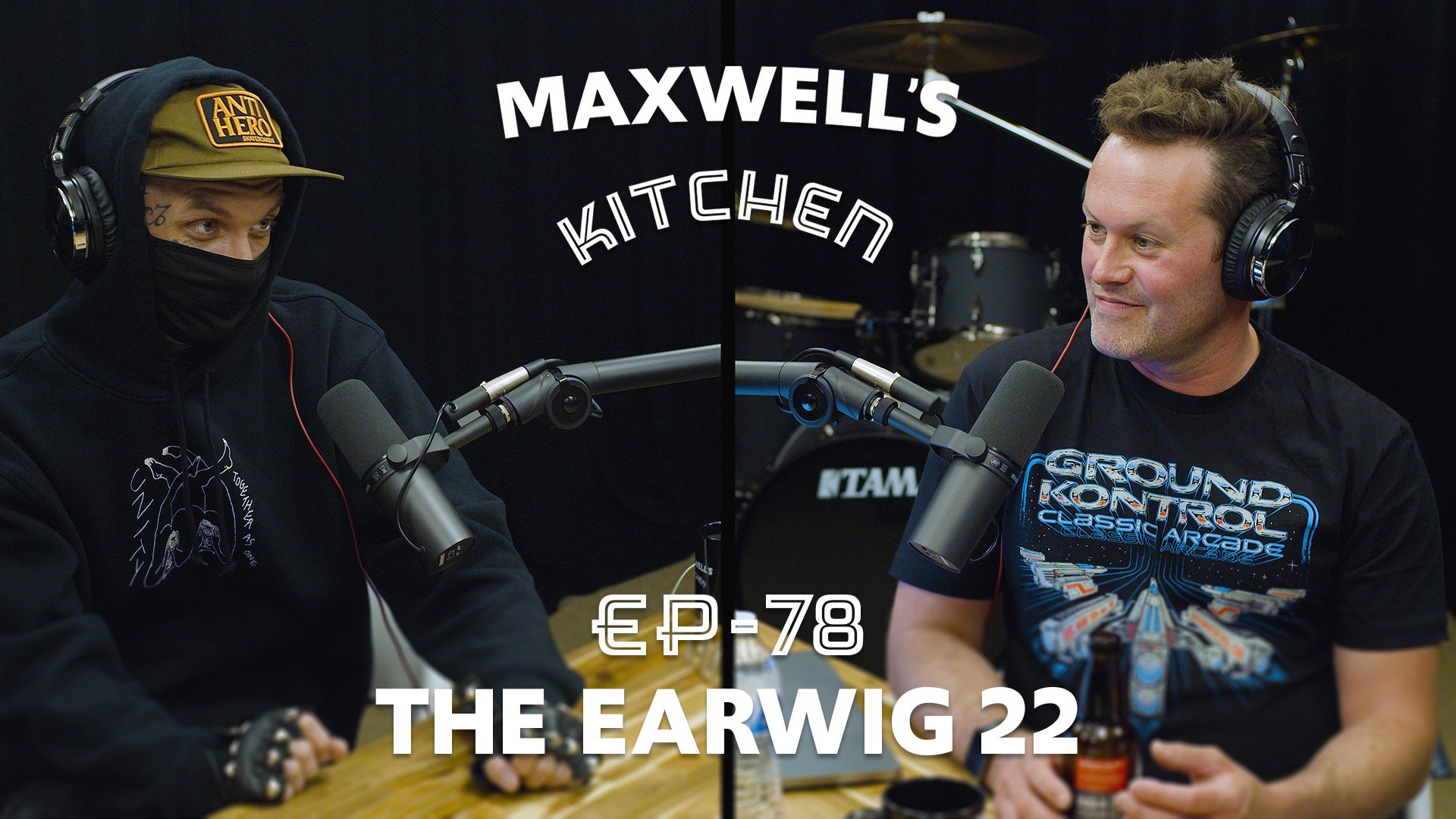
The Earwig 22 did not learn art in school.
He learned it by looking at walls.
Growing up in Mesa, Arizona, he remembers finding a graffiti piece behind a school and becoming obsessed with it before he really understood what graffiti was. The colors were different. The letters were strange. Little shapes came off the piece in ways he could not explain, so he did what kids do when they see something that rearranges their brain a little bit.
He tried to draw it.
Then he drew it again.
Eventually the piece was painted over, but by then the damage was done. Earwig had found something that would follow him through an extraordinarily difficult childhood, addiction, recovery, fatherhood, Portland, murals, commissions, and decades of learning how to control a can of spray paint.
In this episode of Maxwell’s Kitchen, we talk about Portland graffiti and street art from the perspective of someone who has actually spent most of his life inside that world. Earwig explains the culture, the skill, the unwritten rules, the tension between graffiti and murals, and why he believes the difference between making something and simply covering a wall matters.
The conversation also goes much deeper than paint.
In This Episode
Portland graffiti and street art
Growing up in Mesa, Arizona
Discovering graffiti as a kid
Teaching himself to draw and paint
Graffiti writing and style writing
Learning color and composition without art school
Childhood abuse and trauma
Drug addiction and recovery
The story behind The Earwig 22
Turning art into a career
Murals and commissioned work
Graffiti versus street art
Portland’s changing graffiti scene
Technique, spray paint, color, and lettering
Developing a recognizable style
Mentoring younger graffiti writers
Businesses, public space, and respect
Portland Street Art Alliance
Mistakes and improvisation
Making art for money without making art about money
Why finished work can feel alive
Survival, happiness, and what comes next
Guest
The Earwig 22
The Earwig 22 is a Portland-based graffiti writer, illustrator, and muralist whose primary medium is aerosol. His work moves between highly stylized graffiti lettering, characters, murals, illustration, and commissioned art.
He started painting as a teenager and built his style through repetition rather than formal training. That distinction matters throughout our conversation because Earwig does not really separate learning art from living it. Drawing, painting, watching other writers, making mistakes, studying walls, and trying again were the education.
Learning Art From Graffiti
Earwig's mother was an artist, so drawing existed in his life early, but graffiti gave the impulse somewhere to go.
The first piece that really grabbed him appeared during a difficult period for his family. He was still young, moving through parks and unstable situations, when he found this carefully painted thing sitting behind a school. He could see that it was made from letters, but the letters had become something else. They bent, stretched, overlapped, and turned into an image.
That discovery became his version of art school.
Earwig began painting around 12 or 13 and learned color theory, composition, control, and lettering through the work itself. He talks about drawing between painting sessions, planning what he wanted to execute, watching artists he respected, and slowly understanding why one line worked while another did not.
There is an important distinction in the way he talks about graffiti. The goal was not simply to be everywhere. The writers he admired cared about style, skill, and what they could produce under pressure. A piece needed to hold up when somebody who knew the culture stood in front of it.
That standard stayed with him.
When Art Becomes the Thing That Keeps You Moving
Graffiti was also arriving while the rest of Earwig's life was unstable.
He talks openly about growing up with abuse, getting into drugs young, and spending years moving in and out of situations that could easily have swallowed him. Art did not magically erase any of that, but it gave him something that demanded enough attention to compete with it.
The better he became, the more he had to lose.
That mattered.
Earwig describes periods of heavy drug use, serious health consequences, sobriety, relapse, therapy, and the slow process of understanding that somebody else's cruelty was not evidence of something wrong with him.
The name The Earwig comes directly out of that childhood.
He tells the story of an abusive stepfather terrifying him with an earwig after they had watched The Beastmaster. What was originally attached to fear eventually became the identity Earwig carried into his artwork. The 22 developed its own significance later, tied both to his birthday and to a major health crisis during a period of addiction when he was 22.
It is a strange transformation. Something intended to frighten a kid eventually became the name attached to decades of creative work.
Getting Good Takes a Ridiculous Amount of Time
By the time somebody sees an experienced graffiti artist make a line with spray paint, the movement can look almost casual.
Earwig laughs at that idea.
He has spent most of his life practicing.
There were years of drawing, painting walls, making canvases, taking commissions, studying other writers, experimenting with characters, learning how paint behaves, and repeating the same physical motions until his hand understood them without much conscious thought.
That is one of the best parts of the conversation because it removes some of the mythology around creativity. Yes, there is instinct, but there is also an absurd amount of repetition.
Earwig compares graffiti to anything else that requires physical control. You cannot simply want to be good at it. You have to make enough bad work to figure out why it is bad, find influences worth learning from, and slowly develop decisions that become your own.
His style eventually became recognizable enough that I found him because people on Portland Reddit immediately knew whose work I was looking at.
That is what years of repetition can do.
Portland Graffiti, Murals, and the Argument Over What Belongs on a Wall
A large part of our conversation is about Portland itself.
Graffiti had become increasingly visible around the city, especially during the pandemic, and Earwig saw both good and bad in the explosion. More people were discovering something he loved, but he also believed the culture was becoming increasingly disconnected from the discipline that older writers expected.
His criticism is not simply that new graffiti is bad. Everybody starts somewhere. Earwig is much more interested in whether somebody is trying to get better.
That distinction drives his thinking about public space. He has little patience for damaging a small local business just because a blank wall is available, but he is also skeptical of treating every painted surface as if it carries the same meaning. He would rather see experienced artists working with communities, businesses, and property owners to create space where people can paint and develop.
He imagines walls that change constantly, where one artist can paint over another and the point is not permanence. The wall becomes a place to work.
That would not eliminate illegal graffiti. Earwig does not pretend it would. Part of graffiti's attraction has always been that you are not necessarily supposed to be doing it.
But giving people somewhere to practice could create another route into the culture besides simply sending inexperienced writers out to figure everything out on somebody else's building.
Graffiti Is Not the Same Thing as Street Art
Even the language gets complicated.
I ask Earwig whether "graffiti" is the right word, because people outside the culture often reach for "street art" when they are worried graffiti sounds insulting.
Earwig is clear about it.
He makes graffiti.
He considers himself a writer and, more specifically, a style writer. His work can also become murals and commissioned public art, but those categories are not interchangeable.
The difference is partly historical and partly cultural. Graffiti has its own language built around letters, names, repetition, crews, influence, competition, and style. Someone unfamiliar with that language might look at a complicated piece and struggle to read the word at all.
Earwig likes that.
The work does not need to explain itself completely to everyone who passes it.
The Rules Nobody Writes Down
For something usually described from the outside as rule-breaking, graffiti turns out to have a lot of rules.
One of the simplest is that if you are going over somebody else's work, you should be able to do something better.
Earwig talks about respect for older writers, learning from people who came before you, and the value of mentorship. He believes his generation could have done more of that.
Instead of looking at a young kid with a spray can and deciding they are an idiot, an experienced writer has the opportunity to teach them something.
Technique matters, but judgment matters too.
Where are you painting? Who owns the building? Whose work is already there? What happens if you get caught? Is this worth the consequence?
Earwig has lived long enough with his own decisions to understand that the romantic version of "I don't care what happens" eventually runs into rent, family, employment, court records, and the rest of adult life.
Helping somebody become a better artist can also mean helping them avoid learning every lesson the hardest possible way.
Making Money Without Letting Money Make the Art
Earwig began getting paid for artwork when he was still young.
One of the earliest trades he remembers involved painting a Terminator mural inside a tattoo shop in exchange for tattoos that he now admits were terrible.
He kept them.
That feels appropriate.
Over time the work became commissions, murals, canvases, live painting, and jobs for people who specifically wanted his style. Earwig appreciates getting paid, but he is wary of allowing the market to become the reason the work exists.
When an artist starts building everything around what sells, the formula can slowly replace whatever made the work interesting in the first place.
His preferred arrangement is creative freedom. A client can bring an idea, a place, or something meaningful they want included, but Earwig still wants enough room to make the piece feel like his.
He has already spent enough of his life miserable.
He is not particularly interested in making himself miserable for a mural.
Mistakes Become Part of the Piece
One of my favorite moments comes when I ask what happens if he makes a mistake with spray paint.
Earwig says he tries not to.
Fair enough.
But the real answer is more interesting. When something goes wrong, he often works it into the piece. A strange turn in a line can become a feature. A movement he did not plan might give the work a shape he would never have deliberately designed.
Enough of those little accidents can eventually become style.
That is true in music too. A wrong note, odd rhythm, accidental sound, or strange physical habit can become the thing that makes somebody recognizable.
Earwig loves those mistakes because they interrupt perfection.
The artist has to respond.
Leaving Something on the Wall
When Earwig finishes a piece, he sometimes needs to leave it alone for a while before he can decide whether he likes it.
Ten minutes after finishing, he may hate the entire thing. A couple of weeks later, he can come back and see it differently.
Sometimes he will sit near a piece, smoke, look at it, and spend some time with it almost like visiting somebody.
There is a lot of himself inside the thing, but once the work is finished and sitting on a wall, it also stops belonging entirely to him.
Someone can love it. Someone can hate it. Another writer can eventually cover it. The building can disappear.
That impermanence is built into graffiti in a way that most art forms spend enormous amounts of energy trying to avoid.
Earwig seems comfortable with it.
The point was making the thing.
Making the Things You Wanted to See as a Kid
Near the end of the conversation, Earwig talks about wanting to paint bigger work, keep creating around Portland, and make the neighborhood around him more interesting.
By then we have spent more than an hour talking about addiction, abuse, graffiti, money, murals, legal trouble, public space, art communities, mistakes, and survival, but his ambition at 38 sounds surprisingly simple.
Make more. Get better. Enjoy it.
He talks about wanting to feel present in the work instead of constantly chasing recognition or trying to prove something. After everything that has happened in his life, happiness has become a more serious goal than it probably sounded when he was younger.
That also explains why he keeps coming back to the walls.
The first graffiti piece he remembers seeing as a kid gave him something he did not have before. It showed him a strange, colorful world somebody else had invented in a place where he was not expecting to find one.
Decades later, he is still trying to leave some of those behind for the next kid.
Useful Links
The Earwig 22 on Instagram
https://www.instagram.com/theearwig22/
Portland Street Art Alliance
https://www.pdxstreetart.org/
More Interviews
Aaron Draplin on Graphic Design, Field Notes, Nike & Working for Yourself
https://maxwellskitchenpodcast.com/maxwells-kitchen-podcast/2022/06/30-episode-aaron-draplin
Graphic designer Aaron Draplin talks about another version of building a life around making things: client work, creative independence, Nike, Field Notes, money, design, and protecting enough freedom to still enjoy the work.
Woodworking, Furniture Making, and Creativity with Gary Rogowski
https://maxwellskitchenpodcast.com/maxwells-kitchen-podcast/2023/05/22-episode-113-gary-rogowski-the-art-of-woodworking
Furniture maker Gary Rogowski approaches creativity through wood instead of spray paint, but the themes overlap: practice, physical skill, mistakes, discipline, selling creative work, and the strange satisfaction of turning an idea into something that exists.