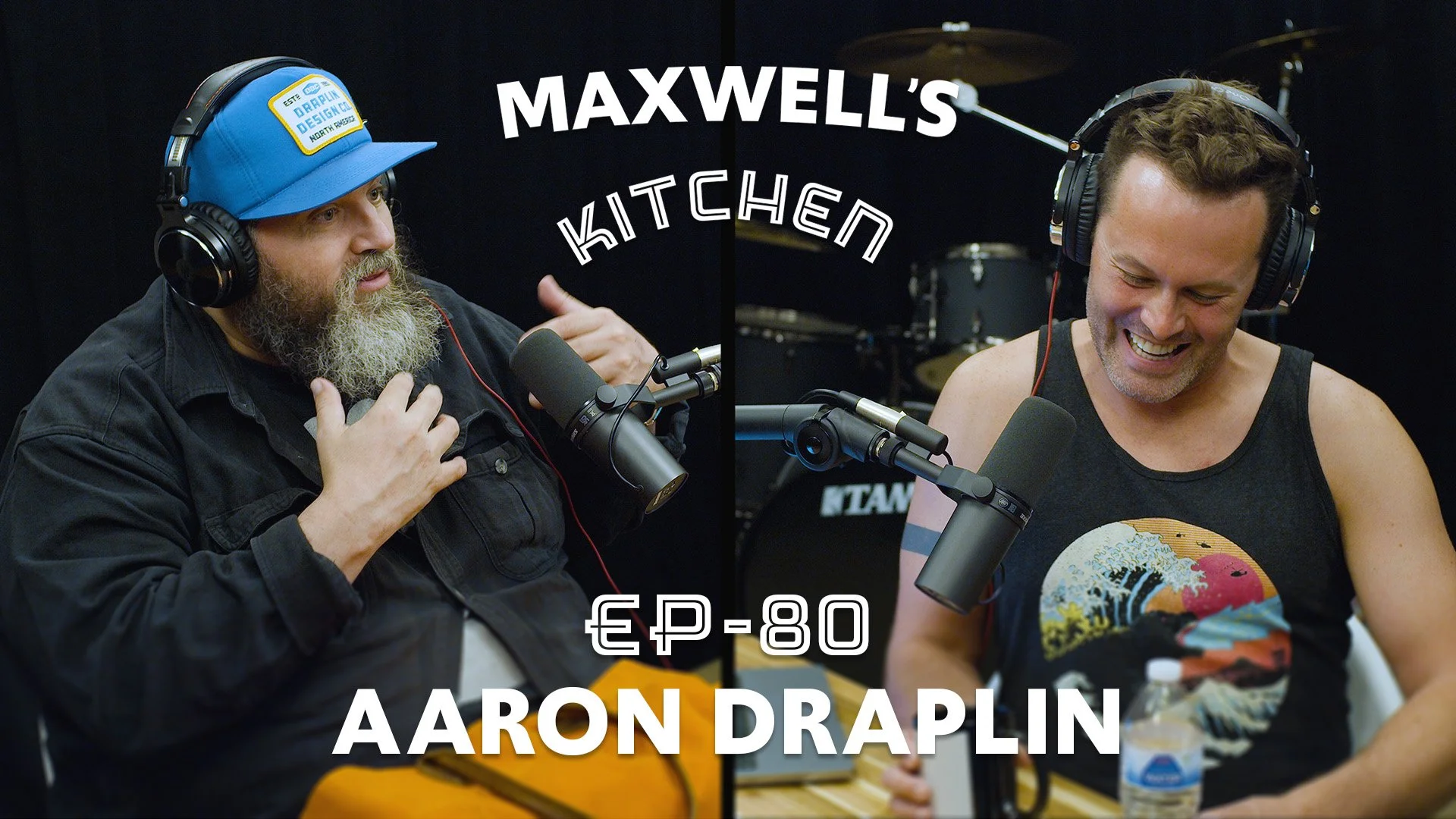
Aaron Draplin has designed things for Nike, Chris Stapleton, snowboard companies, restaurants, record labels, bands, comedians, Field Notes, and plenty of people who probably could not afford him.
He seems equally interested in all of them.
That is one of the things that makes talking to Aaron different from talking to somebody who treats graphic design like a ladder toward progressively more important clients.
He likes making things.
Sometimes that means a giant corporate project. Sometimes it is a sticker for a band. Sometimes it is a memo book he originally made because he wanted one himself.
In this episode of Maxwell’s Kitchen, Aaron talks about graphic design, Field Notes, Nike, going independent, dealing with clients, making money, staying out of debt, working with musicians, creating your own products, and building a career without letting the career become the entire point.
In This Episode
Graphic design and what makes something good
Why context matters before calling design bad
Client feedback and creative compromise
Knowing when a project is good enough
Money, debt, and independence
Turning down work
Designing for musicians and bands
Chris Stapleton
Nike and the Janoski logo
Super Deluxe
Field Notes
Early jobs and learning graphic design
Snowboarding and design
Working at Cinco in Portland
Going independent
Adobe Illustrator and creative tools
Logos and branding
The FedEx logo
Why simple design is difficult
Concert posters and merchandise
Tenacious D, Jack White, Foo Fighters, and Bob Dylan
Public speaking and Adobe MAX
Writing and designing Pretty Much Everything
Respect for working-class jobs
Guest
Aaron Draplin
Aaron Draplin is a Portland-based graphic designer and founder of Draplin Design Co.
His work spans branding, logos, posters, merchandise, music, sporting goods, books, typefaces, and products of his own. He co-created Field Notes, wrote and designed Pretty Much Everything, teaches design online, and has spoken at hundreds of events around the world.
But the interesting part of Aaron’s career is not really the résumé.
It is the way he built it.
Good Design Needs Context
I start by asking Aaron how often he sees a logo or piece of design and immediately thinks it is terrible.
His answer is more generous than I expected.
Before ripping something apart, he wants to know how it got there.
Maybe there was no budget. Maybe five committees mangled it. Maybe somebody’s little brother designed it for a band because that was the only person willing to help.
Aaron saves most of his frustration for work backed by enormous resources that still feels phoned in.
That distinction comes up throughout the conversation.
Design does not exist by itself. Somebody had to make it. Somebody had to approve it. Somebody was paying for it. Somebody needed it to accomplish something.
A designer can have an opinion about how something looks, but the job is bigger than winning an argument about taste.
Clients Are Allowed to Have Opinions
Aaron has also learned not to treat every client revision like a personal attack.
The client is paying for the work.
They get some ownership of it.
That does not mean every decision is good, but Aaron talks about learning when to fight for an idea and when to accept that a project reached 90 percent instead of 110.
If the client destroys the last ten percent, he gets paid and moves on.
That attitude is partly philosophical and partly survival.
Creative people can spend an enormous amount of energy trying to protect every decision they make. Aaron would rather save some of that energy for the things he owns.
Money Buys Independence
That leads into one of the more interesting parts of the conversation.
Aaron likes making money.
He is not embarrassed about that.
What matters is what the money allows him to do.
He talks about getting himself out of debt, paying off his house, keeping expenses under control, and putting himself in a position where he does not have to accept every project that comes along.
A giant paycheck is useful.
Being able to tell somebody no is better.
Aaron describes turning away from certain large corporate projects because he knew the process would consume months of his life and leave him exhausted by the time the work finally appeared.
Instead, he could take the money from jobs that made sense and use it to support smaller work he actually cared about.
That might mean helping a band with no budget, making something with friends, or building a product of his own.
Working With Musicians
Music runs through a lot of Aaron’s work.
He talks about designing for Chris Stapleton, including a deliberately stupid sticker calling him Nashville’s 47th fastest guitar player.
Stapleton liked it.
That matters to Aaron because it says something about the person on the other side of the project.
He likes people who can laugh at themselves.
Aaron also talks about Tenacious D, concert merchandise, Jack Black, Bob Dylan, Jack White, Foo Fighters, record packaging, and what separates merch that feels like somebody cared from something that exists only because a tour needs shirts to sell.
For him, the best work usually has some personality in it.
You should be able to tell somebody had fun making the thing.
From Washing Dishes to Graphic Design
Aaron’s career did not start at Nike.
It started much closer to the bottom.
He talks about washing dishes for summers in Alaska, trimming trees, working factory jobs, delivering pizza, driving injured snowboarders off Mount Hood, and taking whatever work helped him move toward the next thing.
One summer in Alaska paid for his first computer.
Before that, he would ride his bike to Kinko’s and pay for computer time so he could learn the software.
He had already been making snowboard graphics with pen and ink. The computer simply gave him another tool.
Eventually he went back to school at the Minneapolis College of Art and Design.
After graduating, he had opportunities to take more traditional agency jobs.
Instead, he went to Southern California to work at a snowboarding magazine.
There was less money.
It sounded more fun.
Coming Back to Portland
Aaron eventually returned to Portland and worked at Cinco, where he got experience on projects involving brands like Nike, Adidas, Nixon, and others.
That was the respectable design job.
Then he left it.
Going independent gave him control over his schedule and, somewhat unexpectedly, more money.
Aaron says he had been earning around $65,000 at Cinco. His first year working for himself, he made more than $200,000.
More important than the number was what changed around it.
He could say yes to projects whenever he wanted.
He could work with friends.
He could keep smaller clients.
He could take the weird job that might never become anything and see what happened.
Some of those little projects grew.
Field Notes Started as Something Aaron Wanted
Field Notes may be the best example.
Aaron originally made small memo books for himself and his friends.
They were not created because a company hired him to identify an underserved segment of the notebook market.
He just liked them.
Eventually Aaron and Jim Coudal turned the idea into Field Notes.
Suddenly something that started as a box of notebooks became a real business with employees, products, customers, and increasingly large production runs.
Aaron still talks about it like a side project that somehow escaped the basement.
That is part of why it works.
Field Notes represents an important shift in how Aaron thinks about being a designer.
A designer does not have to wait for a client to call.
You can make the product yourself.
Tools Are a Privilege
We also talk about Adobe, Illustrator, Photoshop, and the cost of professional creative tools.
Aaron remembers when buying software could mean spending a huge amount of money up front.
I came into that world later, when Creative Cloud made the same software available through a subscription and suddenly I could teach myself programs that had previously felt financially out of reach.
Aaron’s perspective is that the tools are worth appreciating.
Somebody had to design Illustrator.
Somebody had to build Photoshop.
Somebody had to solve all the boring problems that allow another person to sit down at a laptop and make something.
He tells a story about meeting Adobe engineers and realizing that while many users immediately complained to them about whatever feature annoyed them, his instinct was mostly to say thank you.
Their work allowed him to make his living.
Why Simple Design Works
Toward the end, we get deeper into logos and branding.
The FedEx logo comes up because of the arrow hidden between the E and X.
It is clever.
But Aaron makes a larger point.
A logo cannot carry a terrible company forever.
If FedEx consistently delivers your package on time, at a fair price, without destroying it, the mark gains meaning because of the experience attached to it.
The same thing happens with apps, sports teams, products, and companies.
Graphic design helps create recognition.
The organization has to give that recognition meaning.
That is probably why Aaron gravitates toward simple design.
A good mark does not need to explain everything.
It needs to work.
The Jobs Before the Job Still Matter
One of my favorite parts of the conversation has almost nothing to do with graphic design.
Aaron talks about his dad.
His father sold tooling to manufacturing companies and treated the people on the shop floor with the same respect he gave the owners upstairs.
Aaron remembers watching that.
He remembers being the dishwasher, the pizza guy, the factory worker, and the person at the bottom of somebody else’s hierarchy.
Now he can walk into rooms where people know his work before he introduces himself.
He does not want to forget what the other side of that felt like.
That perspective shows up in the way he talks about clients, printers, delivery drivers, Adobe engineers, musicians, and the people making the actual thing work when everybody else is busy taking credit for it.
Aaron has designed for famous companies and famous people.
He has also spent a career making weird little things with his friends.
Listening to him talk for an hour and a half, it is pretty obvious which part he values more.
Useful Links
More Interviews
Nike History, the Swoosh, Shoe Dog, and Air with Scott Reames
Former Nike historian Scott Reames talks about the Swoosh, Carolyn Davidson, NikeTown, Air Jordan, Shoe Dog, the movie Air, and how Nike built one of the most recognizable brands in the world.
Recording Bands, Audio Engineering, and Studio Life with Adam Lee
Jackpot! Recording Studio engineer Adam Lee talks about creative work from another side of the process: recording bands, working with artists, studio psychology, analog tape, Pro Tools, budgets, and turning an idea into something finished.