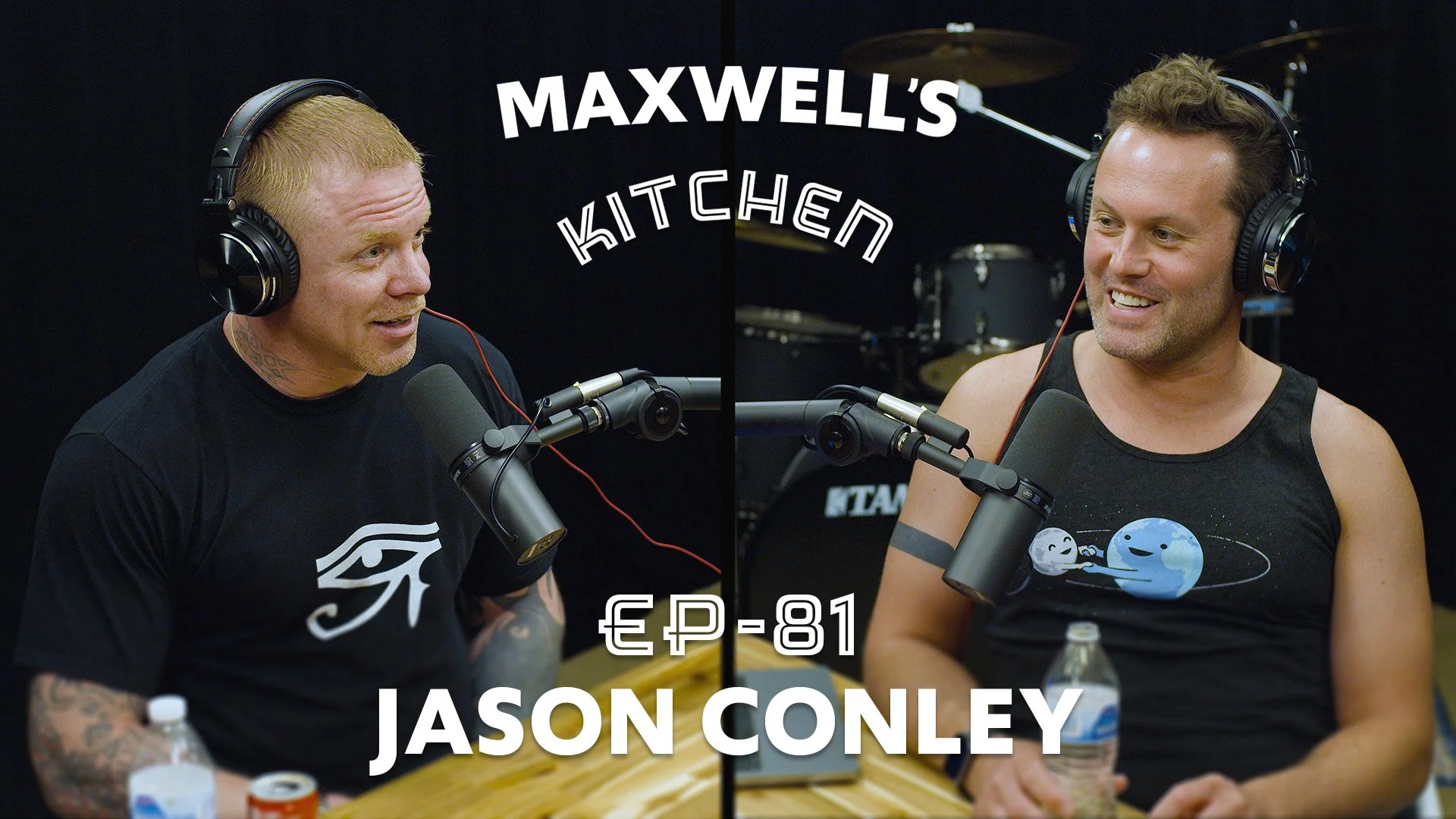
Jason Conley entered the juvenile system when he was 13.
By the time he became an adult, incarceration was not some distant consequence hanging over his life. It was already part of how he understood the world.
Jason spent much of the next three decades moving through juvenile facilities, county jails, federal prison, state prison, addiction, release, and incarceration again. What makes his story interesting is not simply how much time he spent locked up. It is how clearly he can now trace the path that took him there.
In this episode of Maxwell’s Kitchen, Jason talks about growing up around drugs, alcohol, domestic violence, and instability, what happened when the juvenile system became his home, how prison culture shaped his identity, and why getting released did very little to solve the problems that kept sending him back.
Eventually, something finally gave him a reason to imagine a different life.
It was school.
In This Episode
Growing up around addiction and domestic violence
Entering the juvenile system at 13
Group homes and juvenile detention
Juvenile prison
Street culture and violence
Why Jason became critical of juvenile incarceration
His first adult robbery case
County jail
Meth and heroin addiction
Repeated arrests and reentry
Federal gun and drug charges
Federal prison
USP Leavenworth
Race and prison politics
Life on high-security yards
Solitary confinement
State prison versus federal prison
Oregon State Penitentiary
College inside prison
Chemeketa Community College
Education as a turning point
Recovery after release
Rebuilding a life outside prison
Guest
Jason Conley
Jason Conley spent much of his adolescence and adult life inside juvenile facilities, county jails, federal prisons, and the Oregon state prison system.
His story includes addiction, repeated incarceration, federal gun and drug charges, time at high-security federal prisons, and years of trying to return to life outside without having much of a foundation to return to.
While incarcerated at Oregon State Penitentiary, Jason eventually found his way into college classes.
That experience became one of the first things in his life that made the world outside drugs and prison feel genuinely possible.
Entering the System at 13
Jason grew up in California before moving to Chicago.
He talks carefully about his childhood because he does not want the story to become an attack on his mother. He loves her, understands that she was young and struggling herself, and says she eventually got clean.
But home was chaotic.
There was alcohol, drug use, domestic violence, and instability. Jason began running away, spending more time with older kids, fighting, selling drugs, and adopting the kind of street identity that made sense inside the world he was living in.
At 13, he was removed from his mother and entered the juvenile system.
From there came group homes, alternative schools, juvenile detention, a long-term boys placement, and eventually juvenile prison.
Jason believes that experience did more than punish his behavior.
It taught him how to survive incarceration.
Learning How to Be a Prisoner
One of Jason’s strongest criticisms is that the juvenile system often prepares young people for adult prison instead of preparing them to return to the community.
Inside, toughness mattered.
Other kids were watching. Fighting established where you fit. Showing weakness could create problems. The rules that helped somebody survive inside were almost completely useless once that person returned to normal life.
Jason describes himself as a broken kid who gradually turned survival behavior into an identity.
Years passed that way.
Thirteen became fourteen. Fourteen became fifteen. By the time he was released from juvenile prison at 17, the system had already become familiar.
Within about a year, he was facing his first adult felony case.
The First Adult Case
Jason moved to Seattle with his pregnant girlfriend and an older friend who was trying to help him get his life together.
There was a job waiting for him.
It did not last.
Jason started drinking heavily, using drugs, selling drugs, and eventually committed an armed robbery connected to a drug debt.
He was 18.
The case could have carried substantially more time, especially because a firearm was involved, but Jason accepted a plea agreement and spent roughly ten months in King County jail.
He got out without a stable place to live.
There was no dramatic intervention waiting outside the door. Jason found people, sold drugs, used drugs, violated probation, returned to jail, detoxed, got released, and repeated the process.
His drug use escalated from alcohol and methamphetamine to injecting meth and heroin.
Prison was becoming less of an interruption to his life and more of the structure around which the rest of it operated.
Addiction Does Not Stop at the Prison Door
Jason is unusually direct about drug use inside jails and prisons.
Contraband existed. People found ways to get high. Addiction did not disappear because somebody had been locked behind a door.
That creates one of the contradictions we keep coming back to in the conversation.
A person may be incarcerated partly because of behavior connected to addiction, but incarceration alone does not necessarily treat the addiction.
Jason would detox, serve time, get released, and eventually return to the same environment and behavior.
He also talks about how dangerous that transition can be. After a period without opioids, tolerance drops. Returning to the dose someone previously used can become deadly.
For Jason, release did not automatically mean recovery.
For a long time, it simply meant the cycle started again.
When the Federal Government Got Involved
After more arrests and court cases in Oregon, Jason came onto the radar of federal authorities.
He describes being questioned by DEA and ATF agents and realizing that the situation was different from the state cases he had fought before.
Eventually he was arrested in California and extradited back to Oregon on federal gun and drug charges.
Jason received a 92-month federal sentence and later served additional time after violating supervision.
His first federal prison placement was USP Leavenworth in Kansas.
Nothing he had experienced in county jail prepared him for it.
Life in Federal Prison
Jason describes high-security federal prison as a world with its own rules, hierarchies, alliances, and expectations.
New arrivals were immediately evaluated by other prisoners.
Where were you from?
What were you convicted of?
Did you cooperate with the government?
Could people trust you?
Race and geography shaped much of the social structure. Jason explains how prisoners grouped themselves into what were commonly called “cars,” often organized around race and home state.
He had grown up around people from different backgrounds and says many of the racial divisions he encountered inside did not reflect how he had lived outside prison.
But refusing to participate in prison culture could create its own danger.
That is one of the themes running through Jason’s story: the environment teaches behavior that makes sense inside the environment, even when that behavior becomes destructive everywhere else.
State Prison Was Different
Jason eventually returned to prison again, this time in Oregon’s state system.
He immediately noticed differences.
Federal penitentiaries had felt more rigid, organized, and dangerous. Oregon State Penitentiary still had violence, drugs, politics, and hierarchy, but Jason says he did not experience the same constant pressure he had felt in places like Leavenworth.
Unfortunately, changing prison systems did not mean Jason himself had changed.
He continued using drugs, drinking, fighting, and getting into trouble.
At one point he ended up in solitary confinement after another fight.
When he came out, he looked at the time he had left and realized he had once again managed to waste years of his life doing exactly the same things.
Then he saw an opportunity.
College Inside Prison
Oregon State Penitentiary had a college program through Chemeketa Community College.
Jason initially did not qualify.
His disciplinary record was too recent and his custody level was too low. But he found a bridge-to-college writing class that he was allowed to take.
He did extremely well.
A teacher encouraged him to keep going and advocated for him when a spot eventually opened in the college program.
Jason got in.
For the first time, prison started giving him something he could actually take with him when he left.
He studied math, writing, science, and other college subjects using essentially the same curriculum students were taking outside prison. Because normal internet access was restricted, students relied on an offline research database containing books, journals, reference material, and other resources.
By the time Jason was released, he had completed roughly two years of college.
The credits mattered.
The change in perspective mattered more.
Education Changed the Size of Jason’s World
Jason says school forced him to think beyond the small world he had spent most of his life inside.
For years, that world had revolved around drugs, incarceration, violence, survival, and the people immediately around him.
Education introduced him to cultures, ideas, history, and questions he had never spent much time considering.
It also made him question his own values.
That did not instantly solve everything.
Jason is very clear about that.
After release, he struggled again. There was more drug use, more trouble, treatment, sober living, and another attempt to put the pieces together.
But this time he had something to build on.
He continued pursuing school while working on his recovery instead of assuming the only responsible path was to abandon education and immediately take whatever job was available.
For Jason, school became part of recovery.
A Different Direction
There is no moment in Jason’s story where everything suddenly becomes easy.
That is probably why the conversation works.
He knew for years that drugs and prison were destroying his life. Knowing that was not enough to make him stop.
He served long sentences and still returned to the same behavior.
What eventually began to change was the world he could imagine himself belonging to.
Education gave Jason proof that he could succeed at something outside the identity he had carried since he was a teenager.
After spending most of his life learning how to survive prison, he finally had something that could help him learn how to live outside it.
Useful Links
Portland State University Higher Education in Prison
https://www.pdx.edu/liberal-arts-sciences/higher-education-prison
Chemeketa Community College
https://www.chemeketa.edu/
More Interviews
Conflict Resolution, Restorative Justice & Higher Education in Prison with Michelle Harris
https://maxwellskitchenpodcast.com/maxwells-kitchen-podcast/2022/04/25-episode-michelle-harris
Michelle Harris talks about restorative justice, Portland State University, Freed Minds, higher education in prison, and creating better pathways for incarcerated and formerly incarcerated students.
Shane Andrew on Iraq, PTSD, Cartels & Ayahuasca
https://maxwellskitchenpodcast.com/maxwells-kitchen-podcast/2022/08/19-episode-83-shane-basse
Shane Andrew talks about military service, PTSD, trauma, drugs, dangerous choices, traveling through Latin America, ayahuasca, and trying to build a different kind of life.