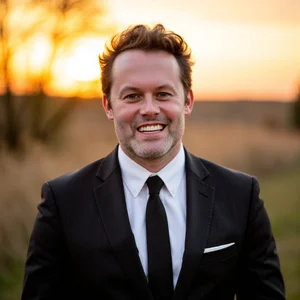
Shane Andrew has spent much of his life looking for the next chapter.
As a kid, he read stories about explorers and imagined his own life the same way. He was less interested in following a normal career path than in reaching the end of his life with enough experiences to make the story interesting.
That instinct eventually took him into the National Guard, to Iraq and Afghanistan, through six chaotic months in Cancún, across South America by bus and boat, into the Peruvian Amazon for ayahuasca ceremonies, and later through parts of Asia while studying spirituality and Buddhism.
In this episode of Maxwell’s Kitchen, Shane tries to explain how all of those versions of his life connect.
The common thread is risk. Early on, he wanted more of it. Later, after war, PTSD, a traumatic brain injury, and what he describes as a kidnapping by members of a Mexican drug cartel, he began looking for a way to keep traveling without constantly making danger the point.
In This Episode
Growing up obsessed with adventure
Joining the National Guard
Serving in Iraq
Working in Afghanistan
Life on military bases
Roadside bombs and combat
PTSD and traumatic brain injury
Moving to Cancún
Selling drugs in the hotel zone
Shane’s account of being kidnapped by cartel members
Leaving Mexico
Backpacking through Latin America
The Darién Gap
Colombia, Ecuador, Peru, Chile, and Argentina
Traveling to Ushuaia
Searching for something beyond adventure
Meeting a shaman in the Peruvian Amazon
Ayahuasca ceremonies
How Shane says ayahuasca affected his PTSD
Reiki training in Thailand
Traveling through Myanmar
Spirituality and Buddhism
Trying to build a different kind of life
Guest
Shane Andrew
Shane Andrew describes himself as an adventurer.
His path included military service and work in Iraq and Afghanistan, followed by years of travel through Latin America and Asia.
He says he has visited roughly 50 countries, studied Spanish while traveling through South America, spent extended time in the Peruvian Amazon, explored different spiritual traditions, and eventually spent years studying Buddhism in Nepal.
The interesting part of Shane’s story is not simply how many places he has been. It is how dramatically his reason for traveling changed.
Looking for the Next Dangerous Story
Shane traces a lot of his personality back to being young and reading about people like Marco Polo. He thought about life as a series of chapters and wanted those chapters to be interesting.
By his late teens, interesting increasingly meant dangerous.
He tells a story about getting into a confrontation outside a Portland bar, being chased home by a man carrying a large knife, and ending up in his front yard with a gun while police arrived.
A neighbor who witnessed some of the chaos happened to be a first sergeant in the National Guard. Not long afterward, Shane was hired to help guard one of the man’s properties after threats had been made against it.
During that job, someone threw a bag at a trailer in the middle of the night and it exploded. Shane remembers the adrenaline more than the fear, and that feeling helped convince him that the military might be exactly where he belonged.
Iraq and Afghanistan
Shane joined the National Guard and went to Iraq in 2003.
He had tested well enough academically that the recruiter suggested becoming a mechanic, which was not exactly the dangerous military adventure Shane imagined. He eventually worked on vehicles, drove for a captain, and volunteered for opportunities that would get him outside the base.
What stands out in his description of Iraq is how quickly an abnormal environment started to feel routine. Rockets and mortars could come into a base, but people still ate, watched movies, used the internet, worked on vehicles, and went through the day.
Shane admits that part of him actively wanted something to happen. He had volunteered to go to Iraq looking for an experience and did not want that experience to consist entirely of sitting behind a fence.
Afghanistan brought him closer to the danger he had been seeking.
During a convoy, an improvised explosive device detonated near the Humvee he was riding in. Shane says the blast damaged the vehicle, punctured the radiator, and later became connected to a traumatic brain injury diagnosis.
At the time, he largely treated the explosion as another experience to add to the story. The effects became harder to ignore later.
When War Followed Him Home
Shane describes a contradiction that followed Iraq and Afghanistan.
He had become accustomed to violence, but his body had not.
He could think of himself as desensitized while still reacting intensely to explosions, sudden noises, and situations that reminded his brain of what had happened overseas.
After returning from Afghanistan, Shane was diagnosed with PTSD and a traumatic brain injury. He explains that the PTSD did not always look like an obvious flashback. Sometimes it showed up as his brain constantly scanning for danger.
That became especially clear after he moved to Cancún.
One day he saw an abandoned mattress sitting in a road and immediately reacted as if it might contain an explosive. In Iraq and Afghanistan, ordinary objects could conceal roadside bombs. Back in civilian life, his brain did not always care that he was somewhere else.
Living in that constant state of alert became exhausting.
Six Months in Cancún
Shane moved to Cancún with a close friend and lived cheaply while receiving disability benefits.
When he needed extra money, he started selling marijuana to tourists around the hotel zone. Customers eventually asked for other drugs, and what began as an easy way to make some money became part of his routine.
Then, according to Shane, he crossed into somebody else’s business.
He describes meeting a man who claimed he wanted to buy everything Shane had. As they walked toward his car, several men approached, grabbed him, pistol-whipped him, and forced him into the trunk of a car.
Shane says he woke up with no immediate memory of where he was. Once it came back, he became convinced he was going to be killed.
The men eventually pulled him from the car, handcuffed him, questioned him, and told him he was selling drugs in territory that belonged to them. Shane says another man arrived, looked him over, and left before someone told him they would have to kill him.
Instead, Shane says the group beat him badly and left him behind. He suffered broken ribs and other injuries.
He never sold drugs again.
Changing the Kind of Adventure
The kidnapping did not instantly make Shane cautious, but it added another layer to everything he was already carrying.
He had spent years intentionally moving toward danger. By then, the accumulated effects of Iraq, Afghanistan, PTSD, drugs, violence, and Cancún were making that kind of life harder to sustain.
Shane began thinking about whether he could still travel and chase unusual experiences without making danger the purpose of the trip.
Eventually he returned to the United States, put a large world map on his wall, and marked all of the places he had visited.
He had thought of himself as a serious world traveler. Looking at the map made him realize how much of it he had never seen.
South America was largely empty, so he chose another destination: Ushuaia, Argentina, near the southern tip of the continent.
Backpacking Across South America
Shane began traveling overland through Latin America with a backpack and very little schedule.
Ushuaia was the destination, but getting there became the real trip.
He stayed in hostels, studied Spanish, took classes, met other travelers, and remained in places he liked for weeks or months at a time. Colombia became one of his favorite countries. He spent extended periods in Ecuador and Bolivia studying Spanish, traveled through Peru and Chile, crossed into Argentina, and eventually reached Ushuaia.
Something else was changing along the way.
Shane says that when he began the journey, he would not have described himself as spiritual. He was an atheist and was not consciously looking for religion, but he was looking for something.
He expected reaching Ushuaia to produce some kind of revelation. Instead, he reached the destination and realized there was no dramatic moment waiting for him there.
The search continued.
Ayahuasca in the Amazon
While staying in Chile, Shane met another traveler who told him about taking ayahuasca with a shaman in the Amazon.
Shane had heard of ayahuasca before and initially approached the idea as another unusual psychedelic experience. He eventually traveled into the Peruvian Amazon and met a shaman near Iquitos.
The ceremonies were far more intense than he expected.
Shane describes powerful hallucinations, encounters with beings he interpreted as alien-like figures, lights that he and other participants believed they could see together, and an overwhelming sense that something had shifted.
We talk about whether those experiences were spiritual, psychological, psychedelic, or some combination of all three. Shane is less concerned with proving what happened than with the effect the experience had on him afterward.
He stayed in the Amazon and says he participated in roughly 30 ayahuasca ceremonies.
For a period afterward, Shane says he experienced a dramatic reduction in the fear, nightmares, and anxiety he associated with PTSD. He does not describe it as a permanent cure, and some of the symptoms eventually returned, but he says the experience changed the direction of his life.
From Risk to Spirituality
Before ayahuasca, Shane says he had little interest in spirituality.
Afterward, he wanted to explore almost everything.
He became interested in Reiki, energy healing, tarot, Buddhism, meditation, and other traditions the earlier version of himself probably would have dismissed.
That curiosity took him to Thailand for Reiki training and then to Myanmar, where he attempted to use what he had learned to help a woman with chronic knee problems.
It did not work.
Shane believed in Reiki while he was learning it, but later became skeptical that he had actually been doing anything. That willingness to reconsider his own beliefs becomes an important part of the story.
The guy who once wanted every trip to include a good chance of something dangerous happening gradually became more interested in why people believe what they believe, how trauma changes the brain, and whether there was another way to build an interesting life.
We do not get anywhere near the end of Shane’s story in this episode, which is why he has to come back.
Useful Links
U.S. Department of Veterans Affairs: PTSD
https://www.ptsd.va.gov/
U.S. Department of Veterans Affairs
https://www.va.gov/
More Interviews
30 Years in Prison: Overcoming Substance Abuse and Recovery with Jason Conley
https://maxwellskitchenpodcast.com/maxwells-kitchen-podcast/2022/07/07-episode-jason-conley
Jason Conley talks about addiction, prison, childhood trauma, recovery, rebuilding his life, and becoming involved in Portland’s recovery community.
Graham Talley on Float Tanks, Sensory Deprivation, and Float On
https://maxwellskitchenpodcast.com/maxwells-kitchen-podcast/2022/11/22-episode-96-graham-talley
Graham Talley talks about sensory deprivation, meditation, psychedelics, mental noise, and why people deliberately seek out unusual experiences that force them to confront what is happening inside their own heads.