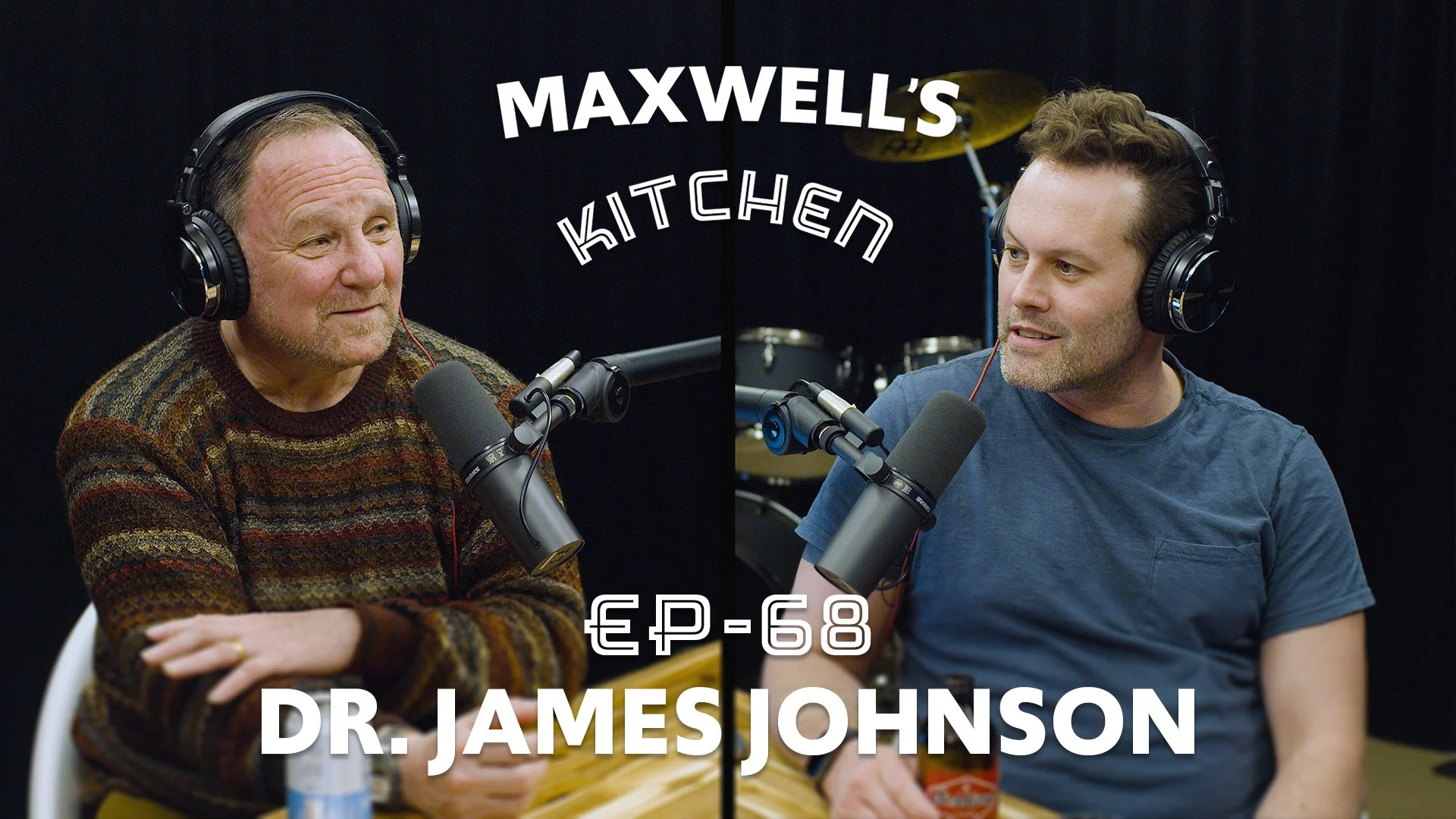
Dr. James Johnson spent nearly forty years trying to understand why people do what they do.
Much of his career as a neuropsychologist involved evaluation. People were referred to him after brain injuries, automobile accidents, questions about diagnosis, or situations where another physician or counselor needed a clearer picture of what was happening. He would interview them, conduct psychological testing, look at how the brain was functioning, and try to make sense of the person sitting in front of him.
By the time we had this conversation, James was preparing to leave that career behind. He was not interested in spending retirement simply repeating what he had done for four decades. His attention had shifted toward self-awareness, spirituality, consciousness, and a much broader question: after forty years of studying the human mind, what had he actually learned about being human?
That takes us through trauma, personality disorders, hypnosis, body language, schizophrenia, nervous-system regulation, relationships, religion, ego, self-judgment, and eventually God.
It went considerably farther than I expected.
In This Episode
Forty years in neuropsychology
How psychological treatment changed over time
Brain injury and neuropsychological evaluation
Trauma and emotional triggers
Trust and physical safety
Reading faces and body language
The nervous system
Fight, flight and freeze responses
Borderline personality disorder
Bipolar disorder
Narcissism
Schizophrenia and psychosis
Hypnosis
Mind chatter and self-consciousness
Choosing a therapist
Self-awareness and personal growth
Spirituality and consciousness
Religion, God and belief
Human connection
Dr. James Johnson
James describes most of his professional career as a mixture of psychological evaluation and therapy.
A large percentage of the people who came through his office were referred by somebody else. A physician might want help understanding a patient's abilities after a brain injury. An attorney might need an evaluation following an accident. A counselor could be looking for clarity around a diagnosis.
That meant James spent decades not only listening to people, but watching them.
He learned to pay attention to facial expressions, body language, tone of voice, movement, hesitation and subtle changes that most people probably would not notice. After thousands of hours across from other human beings, those little signals became part of the way he understood what was happening beneath the conversation.
He had also watched the profession itself change dramatically.
When he finished his doctorate, James remembers psychology as a more experimental and flexible field. Decades later, evidence-based treatment, ethics requirements, documentation, professional boards and stricter expectations had changed the environment considerably.
Some of that was progress.
Some of it frustrated him.
Trauma Begins With Safety
One of the most interesting ideas James returns to throughout the episode is that trauma is fundamentally connected to safety.
When someone is triggered, he does not immediately focus on the story they are telling themselves about the reaction. He looks at what the nervous system is doing.
Does the body think there is a threat?
James describes anger, anxiety, depression, dissociation and other emotional states partly through the body's ancient survival systems. Fight, flight and freeze are not intellectual decisions. They are systems designed to keep an organism alive.
The problem is that they can activate when no tiger is actually chasing you.
A person's tone changes. Somebody steps too close. A relationship reminds you of another relationship. Something happens so quickly that the conscious mind has not even figured out what bothered it yet.
The body reacts first.
Then the mind builds a story explaining why.
James believes learning to recognize that sequence can help people respond differently. Instead of immediately believing every thought attached to an emotional reaction, you can notice what your body is doing and ask whether you are actually in danger.
That sounds simple.
It is not.
Trust Before Technique
James also talks about therapy as something that begins before any technique is applied.
Can the person sitting across from him feel safe?
Can they tell that he is paying attention?
Do they feel judged?
Can they push back without the relationship collapsing?
He describes trust as something physical rather than purely intellectual. A person can tell themselves they trust someone while their nervous system is sending a completely different message.
That is why he pays so much attention to bodies, faces, eyes, voices and changes in energy during a conversation.
James does not believe trauma always needs to be dragged back into the room and relived in detail. If an old memory surfaces, he says the person does not necessarily have to describe the entire event to him. His focus is more on helping them understand what their nervous system learned and how it is trying to protect them now.
The larger goal is not to force somebody into a story.
It is to help them feel safe enough to explore one.
Diagnoses Are Not People
We eventually move into personality disorders, including borderline personality disorder and bipolar disorder.
James is uncomfortable reducing anyone to a diagnostic label.
A diagnosis can describe patterns and help guide treatment, but he keeps bringing the conversation back to the human being carrying that diagnosis.
His discussion of borderline personality disorder is especially tied to trauma and attachment. He believes many people who receive that label have histories that make more sense when viewed through what happened to them and how they learned to adapt.
The same philosophy comes up later when I ask him about narcissism.
My question is basically: how do you tell a narcissist that the world does not revolve around them?
James does not think that is the right starting point.
Why is that person sitting in front of him?
What do they need?
What are they protecting?
How are they trying to adapt?
To James, the diagnosis never replaces the person.
Can Everyone Be Helped?
I keep looking for the category James finds hopeless.
He refuses to give me one.
We talk about schizophrenia and severe psychosis, where someone's ability to distinguish internal experiences from external reality can become profoundly disrupted. James had spent part of his early career working in an acute hospital setting and had seen people during extreme psychiatric crises.
His answer is not that every condition is easy to treat or that every outcome is good.
It is that there is still a human being there.
He remembers watching people begin to emerge as acute symptoms settled. Respect mattered. Gentleness mattered. Being heard mattered. Feeling that another person cared mattered.
James does not pretend he can always solve somebody's condition, and he talks openly about how painful it can be when he cannot reduce a person's suffering as much as he wants.
What he rejects is the idea that a diagnosis makes somebody unreachable.
The Noise Inside Your Head
A lot of the conversation eventually turns toward ordinary mental suffering rather than clinical diagnoses.
You send someone a text.
They answer strangely.
Your boss walks past you without saying anything.
Somebody uses a different tone.
Now your brain is producing seventeen theories about what it means.
Are they angry?
Did you screw something up?
Are you about to get fired?
Did that punctuation mark mean something?
James calls much of this mind chatter.
The mind builds stories constantly, then presents those stories as though they were objective descriptions of reality. His advice is not particularly complicated: learn to stop automatically believing them.
That requires practice.
James compares it to meditation or any other discipline. The goal is not to destroy thought. It is to notice when the thinking itself has taken over and created a problem that may not exist outside your own head.
That idea becomes one of the major bridges between his psychology career and the spiritual direction he was moving toward.
The Psychologist Needed Help Too
One of my favorite parts of the conversation comes when James talks about his own self-awareness training.
After decades of helping other people, he started working with a teacher who challenged the way James understood himself.
During one exercise, James says he suddenly recognized ways he had been cruel to his wife without fully realizing it.
They had been married for decades.
He loved her.
He still had things he could not see about himself.
Instead of treating that realization as proof that he was a terrible person, James describes responding with compassion and changing his behavior.
His wife noticed the difference.
For me, that is one of the strongest parts of the entire episode because it breaks the idea that expertise somehow means arriving at a finished version of yourself.
A psychologist can still need someone else to point out what he cannot see.
Forty years of experience does not eliminate blind spots.
It just gives you forty years worth of opportunities to find new ones.
Psychology Starts Becoming Spiritual
By this point in his career, James was increasingly interested in questions traditional clinical psychology could not completely answer for him.
What happens when you stop judging yourself constantly?
What does consciousness actually consist of?
How much of reality is constructed inside our own minds?
Can people learn to interact without constantly trying to control, compare or dominate each other?
What does love look like when it is not dependent on somebody behaving the way you want them to?
James had begun moving toward spiritual coaching because those questions felt like the natural continuation of what he had already spent his career exploring.
For him, psychology and spirituality were not completely separate territories.
Both were attempts to understand the person underneath the noise.
God, Religion and Belief
Naturally, once we get far enough into spirituality, I start asking about God.
James grew up in fundamentalist Christianity and studied biblical languages, including Greek and Hebrew. He knows the religious tradition well, but his relationship with belief became much less rigid over time.
He does not claim certainty about whether God exists.
Instead, he talks about belief as something a person is responsible for choosing and examining.
His central issue is what that belief does to other people.
If religion makes someone more compassionate, loving and respectful, James sees value in it. If belief becomes another mechanism for superiority, judgment or control, then the belief has become part of the problem.
That leads us into Christianity, sex, morality, prostitution, social judgment and the tendency human beings have to turn almost anything into another reason to divide themselves into groups.
It is an appropriately strange place to end a conversation that started with neuropsychological evaluations.
Forty Years of Trying to Understand People
James spent almost four decades working with human minds and somehow came out of it less interested in pretending he had all the answers.
That may be the most interesting thing about him.
The longer he worked, the more he focused on curiosity, safety, compassion and paying attention to the person in front of him. He became less interested in labels as complete explanations and more interested in understanding how people had adapted to the lives they experienced.
His career also changed him personally. Psychology led into self-awareness. Self-awareness moved toward spirituality. Eventually the questions became much bigger than treatment plans and diagnoses.
How do we become less afraid?
How do we quiet the stories in our heads?
How do we stop needing to be right?
How do we treat each other better?
James does not give me a neat answer to all of that.
After forty years, he seems pretty comfortable admitting there may not be one.
Useful Links
Watch the Episode on YouTube
https://youtu.be/54eg0mtemmA
More Maxwell’s Kitchen Interviews
https://maxwellskitchenpodcast.com/podcast/interviews
More Interviews
Dr. Adam Rodriguez on Borderline Personality Disorder & Narcissism
https://maxwellskitchenpodcast.com/maxwells-kitchen-podcast/2022/09/20-episode-90-dr-adam-rodriguez
Dr. Adam Rodriguez talks psychotherapy, borderline personality disorder, narcissism, attachment, trauma, and how personality patterns develop.
Zara Roth on Borderline Personality Disorder, Trauma & DBT
https://maxwellskitchenpodcast.com/maxwells-kitchen-podcast/2022/10/20-episode-92-zara-roth
Therapist Zara Roth talks borderline personality disorder, dialectical behavior therapy, trauma, anxiety, social media, and emerging psychedelic-assisted therapies.