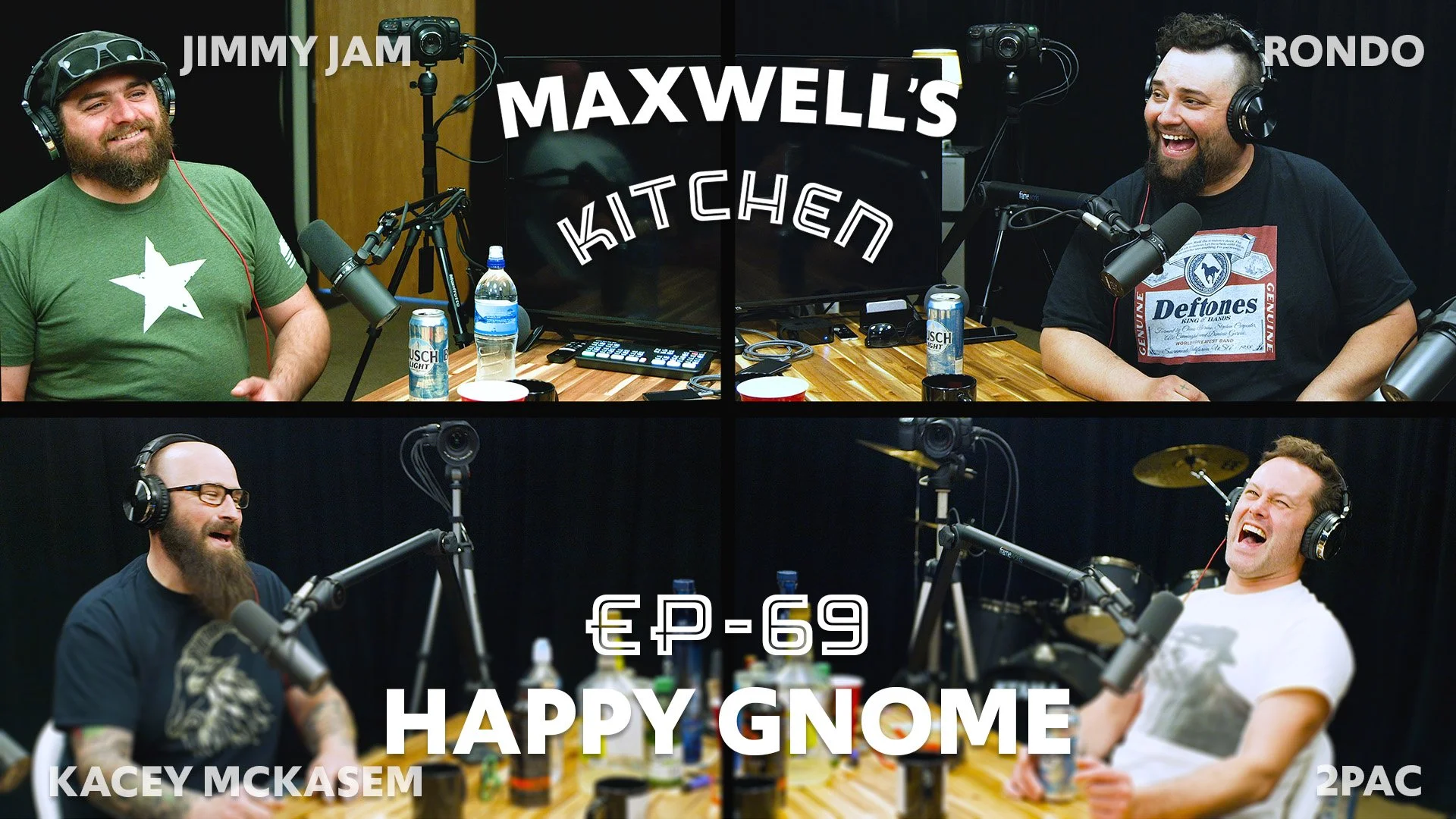
Happy Gnome started the way a lot of teenage bands probably used to start. Somebody had a guitar, somebody else was informed that he should probably buy a bass, a drummer eventually appeared, and nobody involved had much idea what they were doing.
Kasey McCabe, Brandon McBride, and Cody Pando grew up around The Dalles, Oregon, and spent a huge chunk of their teenage years writing songs, practicing anywhere that would hold a drum kit, booking their own shows, recording demos, and trying to build a band out of whatever equipment, money, transportation, and questionable judgment they had available.
This episode is the three of them sitting down with me and trying to reconstruct what happened. That gets complicated because twenty years later, everybody remembers slightly different versions of the same stories. One person remembers exactly where something happened but not when. Somebody else remembers who was there but insists the entire sequence went differently. Then one forgotten detail unlocks another story and suddenly everyone is fifteen again.
It is less a formal band history than a long conversation about growing up together with music running through the middle of it.
In This Episode
Starting Happy Gnome in high school
Kasey McCabe on vocals and guitar
Brandon McBride on bass and vocals
Cody Pando on drums and vocals
Garage-band culture in The Dalles
The origin of the Happy Gnome name
DIY concerts and The Dalles Civic Auditorium
The Columbia Gorge music scene
Recording the first demo
Writing original songs
Terrible practice spaces
Playing Portland
Local bands and venues
The Wenatchee road trip
Almost signing a terrible music deal
Why the band eventually slowed down
Getting back together for a reunion show
Getting older and somehow still remembering the songs
Happy Gnome
Happy Gnome was a three-piece band from The Dalles with Kasey McCabe on vocals and lead guitar, Brandon McBride on bass and vocals, and Cody Pando on drums and vocals.
The earliest version began while Kasey and Brandon were still in high school. Kasey remembers sitting next to Brandon in class and asking if he wanted to start a band. There was only one minor problem: Brandon did not play bass.
Kasey's response was essentially, get one.
Kasey had started learning guitar after trading in the trumpet he played in middle school. Brandon eventually got a bass around his sixteenth birthday, and an early version of the band began taking shape. There were other people involved before the final lineup settled in, including another drummer, which is why Cody still refers to himself as the replacement.
Once the three of them were together, Happy Gnome became much more than something they did occasionally after school. The band became the center of a large part of their teenage lives.
Garages, Basements and Anywhere Else They Could Play
There was a logistical problem with starting a rock band before everybody could make an entire record on a laptop. You needed physical instruments, amplifiers, drums, microphones, cables and, most importantly, somewhere your parents would allow you to make an unreasonable amount of noise.
Happy Gnome went through garages, bedrooms, basements and eventually commercial spaces that only loosely qualified as buildings.
At Kasey's house, his mom would occasionally come in while they were blasting away and ask why everything had to be so loud and aggressive. Why couldn't they play something nice? Maybe some Beatles?
They did not take the suggestion.
The band practiced constantly. If somebody did not have football, baseball, work or another obligation, they would head to somebody's house and play. Looking back, that repetition explains why the songs stayed buried in their heads long after Happy Gnome stopped being an active band.
Years later, when they reunited, nobody needed to relearn everything from zero. The changes, stops and little cues between them were still there.
How Happy Gnome Got Its Name
There is no profound story behind the name.
Kasey remembers being stoned in high school and asking a classmate who was good at drawing to sketch a gnome. They had been trying to come up with band names, most of which have either been forgotten or deserved to be forgotten.
She drew the gnome and wrote “Happy Gnome” underneath it.
That stuck.
The artwork became part of the band's identity, and eventually tattoos of the gnome entered the picture. Not everybody followed through with getting one, which becomes another argument during the episode because apparently a teenage decision involving a permanent cartoon gnome still requires accountability twenty years later.
Putting On Their Own Shows
Nobody was exactly waiting around in The Dalles looking for three teenagers to headline a show, so Happy Gnome started figuring out how to put concerts together themselves.
The Dalles Civic Auditorium became one of the important early venues. Kasey remembers going in and pitching the idea of an alcohol-free, drug-free event featuring local teenage bands. The building could be rented relatively cheaply, and his dad suggested they go around town asking businesses to sponsor the show rather than paying for everything themselves.
Somehow, it worked.
They collected several hundred dollars from local sponsors, got things like soda donated, charged a few dollars at the door, and eventually drew hundreds of people to one of the larger shows. There was even a Happy Gnome-specific admission policy for a while: bring a lawn gnome and you could get in free.
The stolen decorative gnomes of The Dalles apparently ended up onstage.
It was teenage event production with almost no infrastructure and just enough business sense to keep it alive.
The Columbia Gorge Music Scene
As everyone starts remembering the shows, the episode becomes a little time capsule of the music scene around The Dalles and the Columbia Gorge in the early 2000s.
Happy Gnome talks about bands including Hotboxed, One Star Sky, Misled Mayhem and others playing around The Dalles, Hood River, White Salmon and eventually Portland. There was competition, but the larger memory is of a surprisingly supportive little scene where everyone seemed to know everyone.
Older bands helped younger bands get shows. Someone would have a PA. Somebody else knew where you could play. People loaned equipment, shared bills and showed up for each other's concerts.
Hotboxed comes up several times because they had been doing larger local shows before Happy Gnome and gave the younger bands something to look toward. Happy Gnome eventually started creating its own events and bringing other bands in, which made the whole thing feel bigger than three guys practicing in a garage.
For a teenager in The Dalles, it probably felt enormous.
The Practice Space That Should Have Killed Somebody
Eventually the band got access to a practice space that became legendary in their memories and would probably be immediately condemned if any responsible adult inspected it.
The building had been used for storage and contained rough rooms that local musicians could rent. Happy Gnome turned part of it into a combination rehearsal room, recording space, clubhouse, occasional bedroom and general headquarters.
There was a trampoline, a basketball hoop, a dartboard, old athletic mats, random furniture and a makeshift sound room built with leftover carpet. Plumbing was basically a rumor. Cody lived there for stretches of time. People came over after bars closed. Bands rehearsed. Songs got written. Some nights ended with somebody sleeping wherever there was enough room.
There were also exposed wires and plenty of other evidence that nobody had conducted much of a safety review. During one practice, Kasey hit a live wire with a loose guitar string and remembers the string arcing and glowing red as the electricity ran through it.
The response was not to find another building.
They kept playing there.
Looking back, the place sounds objectively awful, but that is part of why everyone remembers it so fondly. It was theirs. They could make noise, stay up late, bring people over, record music and feel like they had built their own little world inside an otherwise terrible room.
Most people have some version of a place like that from when they were young. You would never live there now, but walking into it exactly as it existed then would probably wreck you.
Recording the First Happy Gnome Demo
After one of their bigger Civic Auditorium shows, Happy Gnome actually had money left over.
They used it to record.
The first proper demo included songs they remember as “Deaf,” “Anti-Hero,” “Among the Faceless,” “Teenage Youth” and “Five Minutes,” with “Get Up” also connected to those early recordings.
They were still teenagers.
For the first time, however, they had something physical to hand people. They could sell CDs at shows instead of simply telling people they had a band.
That meant doing a photo shoot and attempting to look organized. They even discussed coordinating what everybody would wear beforehand, which immediately fell apart when someone showed up wearing the wrong thing.
This is more or less how Happy Gnome operated. There was enough planning to keep moving, but never enough to eliminate the possibility of chaos.
How Happy Gnome Wrote Songs
The band's songwriting process was wonderfully unsophisticated.
A lot of the songs began with Kasey working out riffs on acoustic guitar. He would bring an idea to Brandon, who would find a bass part, then Cody would add drums and the three of them would start shaping it together.
They did not spend much time communicating in conventional musical language. Nobody was announcing specific chord names or analyzing time signatures. Like a lot of bands, they developed their own vocabulary consisting mainly of noises, numbers and references to whatever part everybody somehow understood.
Kasey could say something approximating “the duh-duh-bom-bom part,” and everybody knew what he meant.
As they got older, the songs became more complicated. Everyone started contributing more ideas, the rhythms got more interesting and the arrangements developed beyond the straightforward material they had written when they were sixteen.
They could hear themselves getting better.
Playing Portland and Almost Doing Music Business
Happy Gnome eventually made its way into Portland shows, including the Paris Theatre, where they ran into one of the less romantic traditions of small-band life: selling tickets yourself.
The promoter would give the band a pile of tickets and tell them how many had to be sold. Happy Gnome was much better at playing shows than operating a regional ticket-sales organization, so some of those tickets ended up being given away.
At another point, somebody offered the band what appeared to be a music-industry opportunity. Years later, everyone remembers pieces of it but not enough to reconstruct the entire agreement.
They remember enough to know it probably was not a great deal.
There was talk of representation, money the band would ultimately be responsible for, ownership and pressure to write more songs resembling whatever somebody else thought was commercially promising.
That last part triggered the predictable reaction from young musicians. The second somebody told them which song they should make more of, they immediately wanted to write anything else.
Whatever the agreement was, Happy Gnome did not become trapped in a twenty-year recording contract.
So that worked out.
The Wenatchee Tour
Calling it a tour is being charitable, but that is what it felt like.
After the demo and some successful local shows, there was enough money around to make a trip to Wenatchee, Washington. Happy Gnome and another band loaded into an old bus and headed north for what was supposed to be a real out-of-town show.
This was the dream.
Bands on a bus. Equipment in the back. A show several hours away. For a group of teenagers from The Dalles, they were basically Led Zeppelin.
Then they got to Wenatchee.
Almost nobody was there.
They eventually figured out that a major local sporting event was happening at the same time, and the potential audience had chosen that instead of an unknown teenage rock band from Oregon.
A couple of people were persuaded to come inside. The bands largely played for each other. All the money and effort involved in getting there made absolutely no financial sense.
Nobody regrets going.
That is one of the funny things about being young. A terrible business decision can become a better story than a profitable one.
How It Slowly Ended
Happy Gnome did not have the dramatic breakup scene where somebody throws a guitar and storms out forever.
Life gradually dismantled it.
They graduated. People moved. Work became more serious. Relationships changed. Cody started playing with other musicians. At one point he left to work on a boat, which everybody seems to agree was one of the moments when maintaining the band became significantly harder.
They still played and recorded when they could. Around nineteen, they recorded another batch of songs that represented how much their writing had changed since the first demo. Those recordings were never fully mixed or finished, leaving behind rough versions of a band that was still developing but running out of time to keep doing it.
Eventually Happy Gnome became something they had done rather than something they were actively doing.
Then enough years passed that getting together again started sounding fun.
The Happy Gnome Reunion
Preparing for the reunion meant first figuring out what songs existed.
They started writing everything down. Originals, covers, fragments, riffs, anything anybody remembered. The list approached thirty songs.
Then they plugged everything in.
What surprised them was how quickly it came back.
The stops were still there. The transitions were still there. Everybody remembered little parts that had not been consciously thought about in years. Muscle memory had apparently been storing an entire Happy Gnome set while everybody was off becoming adults.
The rehearsals were different now because their kids were around. Everybody had jobs, families and bodies that did not necessarily appreciate hours of loud music the way they once had.
But the feeling of playing together was still familiar.
They eventually got back onstage for a reunion show in front of people who remembered the band from the first time around. Naturally, the show included its own collection of chaos because Happy Gnome apparently remains incapable of simply playing music without something weird happening around them.
Still, they played.
And it worked.
What Happy Gnome Actually Became
By the end of the conversation, whether Happy Gnome was ever a successful band seems almost irrelevant.
They wrote songs together when they were kids. They recorded music. They put on shows. Sometimes hundreds of people came. Sometimes practically nobody did. They made money, immediately spent it, loaded equipment into terrible vehicles, slept in buildings without proper bathrooms and argued about things that seemed incredibly important when everyone was seventeen.
Then they got older.
Kasey, Brandon and Cody are still part of each other's lives. Their families overlap. Their kids know one another. They can go years without playing together, pick up their instruments and still remember where the changes are.
That seems like a pretty good outcome for a band that started when one kid looked at another kid in high school and asked if he wanted to play bass.
He didn't play bass.
He bought one.
The rest happened from there.
Useful Links
Watch Happy Gnome on YouTube
https://youtu.be/dvPgQ4KYNKY
Maxwell’s Kitchen Interviews
https://maxwellskitchenpodcast.com/podcast/interviews
More Music Conversations
Adam Lee on Recording Bands, Audio Engineering & Studio Life
https://maxwellskitchenpodcast.com/maxwells-kitchen-podcast/2023/02/28-episode-108-adam-lee
Adam Lee and I talk about recording bands, microphones, studio sessions, engineering, producing music, and what actually happens once musicians walk into a recording studio.
Terry Currier on Music Millennium, Vinyl & Record Store Culture
https://maxwellskitchenpodcast.com/maxwells-kitchen-podcast/2022/12/12-episode-99-terry-currier
Music Millennium owner Terry Currier talks about a lifetime in music, vinyl records, Portland record stores, Record Store Day, and how the way people discover music has changed.
Why Is This Song So Good? Song Breakdowns
https://maxwellskitchenpodcast.com/podcast/song-breakdowns
My song breakdown series exploring chords, arrangements, guitar parts, dynamics, and why certain songs work.