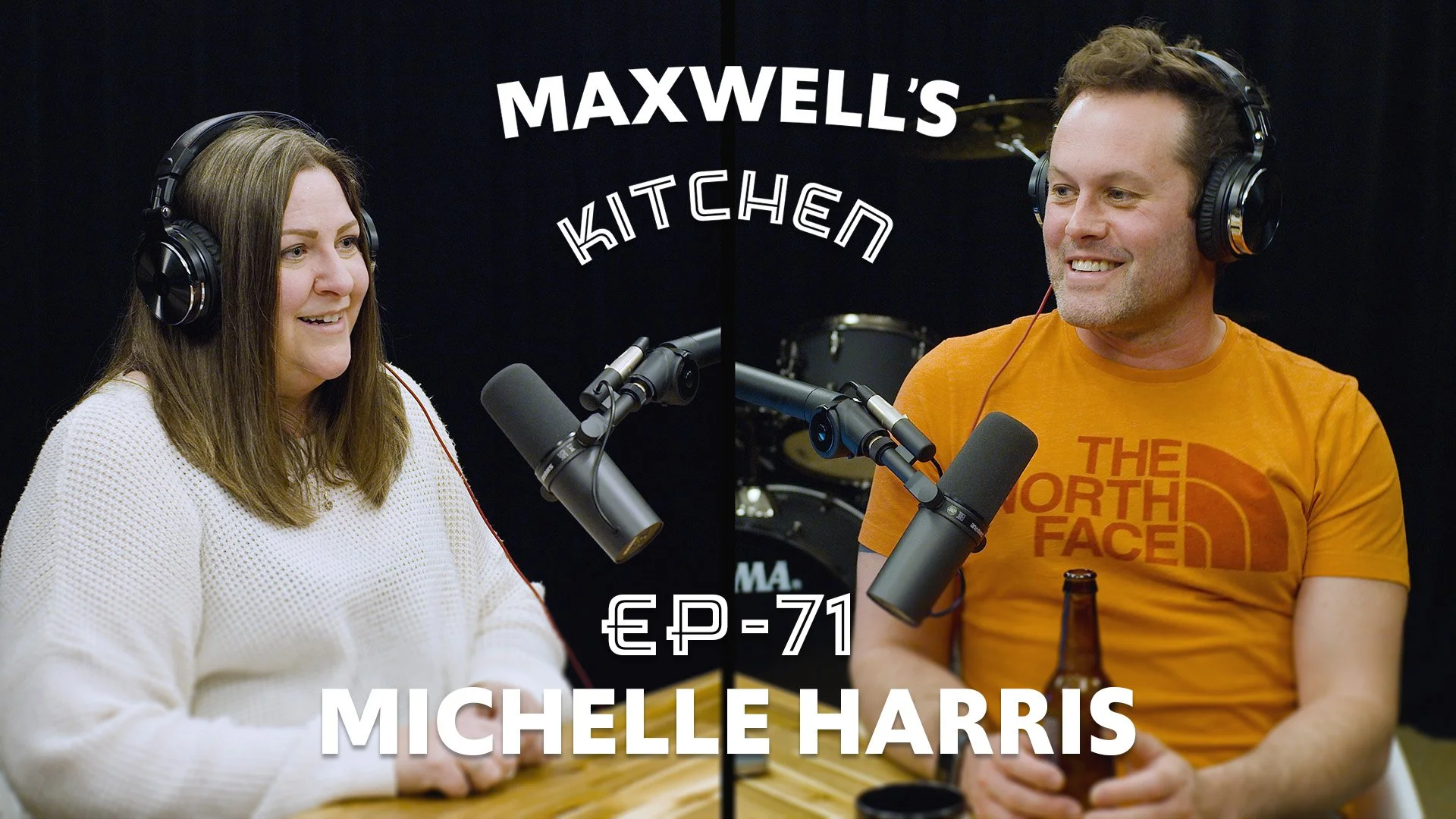
Michelle Harris spends a lot of time thinking about what happens after punishment.
Someone commits a crime. They go through the court system. Maybe they spend years in prison. Eventually, most people come home.
Then what?
In this conversation, Michelle and I talk about the enormous gap between punishing someone for what they did and actually preparing them to return to a community, find work, go to school, rebuild relationships, and make a different life.
Michelle is studying Conflict Resolution at Portland State University with a focus on restorative justice and restorative practices. She also works with programs supporting students affected by incarceration, including Freed Minds, PSU Rebound, and Portland State’s Higher Education in Prison program.
What starts as a conversation about a student organization quickly becomes a much larger discussion about prison labor, mandatory minimum sentences, plea bargains, parole, college access, student debt, inequality, education, and whether our systems are actually designed to help people improve.
In This Episode
Freed Minds and justice-impacted students
Prison education
Restorative justice
Reentry after incarceration
Mandatory minimum sentences
Prison labor
Plea bargains
Public defenders
Parole and supervision
College access
Financial aid
Student debt
PSU Rebound
Higher Education in Prison
Restorative practices in schools
Income inequality
Empathy and community
Guest
Michelle Harris
Michelle is a graduate student in Portland State University’s Conflict Resolution program with a focus on restorative justice and restorative practices in education.
She is also involved in several programs at PSU aimed at helping students navigate higher education, including people who have experienced incarceration or have been affected by incarceration through their families.
One of those groups is Freed Minds.
The organization began as a student group for people whose lives had been touched by the justice system. That includes people who had been incarcerated themselves, people with incarcerated family members, and others affected by incarceration.
The basic idea is pretty simple.
People coming back from prison already have enough barriers.
College does not need to become another one.
What Happens After Prison?
A huge portion of this conversation is really about what happens when somebody gets out.
Prison is often described as correctional.
Michelle questions how much correction actually happens.
Someone may spend five, ten, or fifteen years inside and eventually walk back into a world that has completely changed. Technology has changed. Jobs have changed. Housing has changed. The people they knew have changed.
Michelle talks about knowing people who left prison after long sentences and had never really used smartphones, Gmail, Google Docs, or other technology that had become completely normal while they were gone.
Then we expect them to get a job.
Find housing.
Pay supervision fees.
Reconnect with their family.
Follow parole requirements.
Stay away from whatever circumstances contributed to their original problems.
And somehow figure all of that out immediately.
The question becomes obvious.
What exactly did we do during all those years to prepare them for this?
Education as a Way Back
That is where Michelle’s work comes in.
She sees education as one of the strongest tools available for people trying to build a different life after incarceration.
Through her work at Portland State, she helps students figure out how to enroll, find financial aid, navigate university systems, connect with resources, and understand what options are actually available to them.
A lot of that sounds basic until you imagine trying to do it after years away from normal life.
Even applying for school can become overwhelming if you do not know how financial aid works, where to find transcripts, how to use online systems, or whether your criminal record disqualifies you from something.
Michelle’s goal is not simply to tell people they should go to college.
It is to make college an actual option.
Prison Labor and the Strange Economics of Incarceration
Early in the conversation, we get into prison labor.
Michelle explains that people in prison can work jobs while incarcerated, sometimes doing manufacturing, institutional work, or jobs connected to outside industries.
They may be paid extremely little.
That creates one of the stranger contradictions in the system.
Someone can spend years working while incarcerated, potentially learning useful skills, and then leave prison only to discover that their criminal record makes it difficult to get hired doing similar work.
We talk about incarcerated people fighting wildfires as another example.
You can potentially be trained to do dangerous work while incarcerated, then face barriers to doing that same work professionally once you are released.
That does not make a lot of sense if the goal is rehabilitation.
Mandatory Minimums and One Bad Decision
We also spend time talking about mandatory minimum sentencing.
The basic problem Michelle sees is that fixed sentencing rules remove context.
Two cases can technically fall under the same law while involving completely different people, circumstances, histories, and levels of harm.
Mandatory sentencing can flatten all of that.
Our conversation keeps returning to the reality that people sometimes make terrible decisions.
Some decisions absolutely require serious consequences.
But Michelle argues that defining someone permanently by the worst decision they ever made makes it much harder for that person to become anything else.
The system can keep punishing someone long after the official punishment is supposed to be over.
The Plea Deal Problem
Another part of the system that surprised me was how much depends on plea bargains.
Michelle explains what the decision can look like from the perspective of somebody facing prosecution.
Maybe you believe you have a defense.
But you cannot afford an expensive attorney.
Your public defender has an enormous caseload.
Expert witnesses cost money.
Going to trial could expose you to a much longer sentence.
Then somebody offers you a deal.
Take five years now or risk twenty-five.
Even if you think you might win, five suddenly starts looking pretty attractive.
That does not mean public defenders are trying to hurt their clients. Michelle points out that many are simply buried under more cases than any person could reasonably handle.
The machinery keeps moving.
Each individual person inside it has limited time.
Unfortunately, the thing being processed is somebody’s life.
Coming Home With More Problems Than You Left With
Getting released does not mean the system disappears.
Michelle talks about parole and probation requirements, supervision costs, restitution, employment requirements, and the difficulty of trying to satisfy all of those demands while rebuilding a life.
There can be an especially strange conflict between employment and education.
Someone may be required to maintain full-time employment while also trying to return to school.
Anyone who has attempted full-time work and full-time college knows exactly how pleasant that arrangement is.
Add children, transportation, court obligations, financial problems, and rebuilding family relationships and it becomes even harder.
Michelle’s work is partly about having someone there who can say:
There is another option.
Here is the person you need to call.
Here is how financial aid works.
Here is where you can get food.
Here is career help.
Here is someone else who has been through this.
That support matters.
College Is Not Particularly Easy for Anyone
The conversation eventually expands beyond incarceration into the cost of education itself.
Michelle has plenty of firsthand experience there too.
She talks about student loans, grants, teacher education, and the increasingly strange expectation that more jobs require degrees while the price of getting those degrees keeps going up.
At one point she tells me she has about $76,000 in student loan debt.
Her repayment strategy?
“I will die first.”
I laughed because it is funny.
It is also an absolutely terrible summary of how normal enormous student debt has become.
We talk about the idea that college should be available without pretending it is the only legitimate path.
Trade programs matter.
Certificates matter.
Learning on the job matters.
A four-year degree can be incredibly valuable.
It also should not require somebody to financially kneecap themselves for the next thirty years.
What Restorative Justice Actually Means
Around an hour into the conversation, Michelle explains the philosophy at the center of her work.
Restorative justice is not simply letting somebody off the hook.
It is almost the opposite.
Instead of focusing entirely on punishment, restorative practices ask what harm occurred, who was affected, what accountability looks like, and what would actually help repair the damage.
The person who caused the harm still has responsibility.
But the process is aimed at understanding what happened and reintegrating people into a community rather than simply removing them from it forever.
Michelle points out that restorative practices are not some brand-new academic invention. Indigenous communities have used forms of restorative justice for generations.
The difficult part is applying those ideas inside systems that have been built primarily around punishment.
Start Before Prison
Michelle does not want to stop at the criminal-justice system.
She wants to bring restorative practices into schools.
The logic makes sense.
If a student gets into trouble, the response is often punitive almost immediately.
Send them out of class.
Send them to the principal.
Suspend them.
Remove them from school.
Potentially bring police or the juvenile justice system into the situation.
Michelle wants teachers to have more tools before things reach that point.
What happened?
Who was harmed?
Why did it happen?
What does the student need to do to repair the situation?
How do we bring them back into the classroom rather than simply pushing them farther away from it?
She plans to continue working in higher education and hopes to develop curriculum and teach future educators how to use restorative practices in their own classrooms.
The idea is to start earlier.
Do not wait until somebody is sitting in prison to finally ask what went wrong.
The System Gets Bigger Than the Person
One of the things that becomes clear throughout the episode is how quickly one mistake can spread into everything else.
Someone gets arrested.
They lose their job.
Now their household loses income.
Maybe their kids lose stability.
Maybe rent becomes a problem.
Their employer has to replace them.
Their family is dealing with the consequences.
The impact is much larger than the person who committed the original offense.
Michelle believes we lose something when we treat that person as a case number rather than a human being inside a much larger network of people.
That does not eliminate responsibility.
It acknowledges reality.
People exist inside families, jobs, neighborhoods, schools, and communities.
When one person falls apart, the effects do not stop with them.
Make Eye Contact
Toward the end, Michelle tells me about one of her professors at PSU.
At the end of class, he would encourage students to go outside and simply make eye contact with people.
Not give them a speech.
Not save the world.
Just look at people.
See them.
He also would not let students sit in the same place with the same people every class. Move around. Meet somebody else. Talk to someone you do not already know.
It sounds almost ridiculously simple.
But it connects directly to everything Michelle has been talking about for the previous hour.
It is much easier to dismiss somebody when they are just a category.
Felon.
Prisoner.
Student.
Cashier.
Homeless person.
Parolee.
Customer.
Once you actually see an individual human being, things get more complicated.
That person has parents.
Kids.
Bills.
A terrible day.
Something they regret.
Something they are trying to fix.
Michelle’s work is built around creating systems that leave room for that complexity.
People should be accountable for what they do.
They should also have a reasonable chance to do something different next.
Useful Links
Portland State University Higher Education in Prison
https://www.pdx.edu/liberal-arts-sciences/higher-education-prison
Watch the Episode on YouTube
https://youtu.be/OuW7do1R61A
More Maxwell’s Kitchen Interviews
https://maxwellskitchenpodcast.com/podcast/interviews
More Interviews
Jason Conley on Prison, Addiction, Recovery & Education
https://maxwellskitchenpodcast.com/maxwells-kitchen-podcast/2022/07/07-episode-jason-conley
Jason Conley talks about juvenile detention, addiction, federal and state prison, reentry, recovery, and the role education played in changing his life.
Dr. Christopher Carey on Human Trafficking & Criminal Justice
https://maxwellskitchenpodcast.com/maxwells-kitchen-podcast/2022/10/17-episode-94-dr-christopher-carey
Portland State professor Dr. Christopher Carey talks about human trafficking, criminal justice, human rights, law enforcement, and how trafficking cases actually work.